
Referral program software tracks who a customer invited and rewards both sides after that invite becomes a paying customer. For a SaaS company, the real differences are price and billing fit. Some tools also need a sales call just to get a number.
This comparison draws on each tool's own pricing and feature pages and Stripe's coupon docs, all read in November 2026. One thing to know first: we make OpenPromoter. So it is one of the eight tools below, scored on the same checklist as the rest.
You get a checklist for what matters in a referral platform and all eight tools scored against it. A pricing table lines up entry cost and payout fees side by side. After that comes how a referral program differs from an affiliate program and how to add one to your own app.
What Is Referral Program Software?
Referral program software gives each customer a personal link and tracks who clicks it. It pays a reward once a referred friend becomes a paying customer, usually a discount or account credit. Most tools market themselves as a referral platform, the same thing under another name.
The link usually lives inside the product itself, in account settings or a billing page. That is the main difference from affiliate software, which is built around outside partners who apply and get approved first.
Our guide to building a SaaS referral program covers the five setup decisions behind one, from the reward to the refund window. This post picks up after that decision and compares the tools that run it.
A referral platform usually reports three numbers for each customer: clicks on their link, friends who signed up and friends who paid. Clicks and signups are useful for knowing who to thank.
Only the paid number should trigger a reward, and that rule drives most of the checklist in the next section. A dashboard that mixes signups into the reward count will pay for traffic that never converts. A link that is easy to share also gets clicked more in texts and group chats.
A referral program that never checks for duplicate accounts pays out on referrals that are not real. Most platforms on this list, OpenPromoter included, block a referral when the signup shares a device, IP address or card with the referrer.
What to Check Before You Buy Referral Program Software
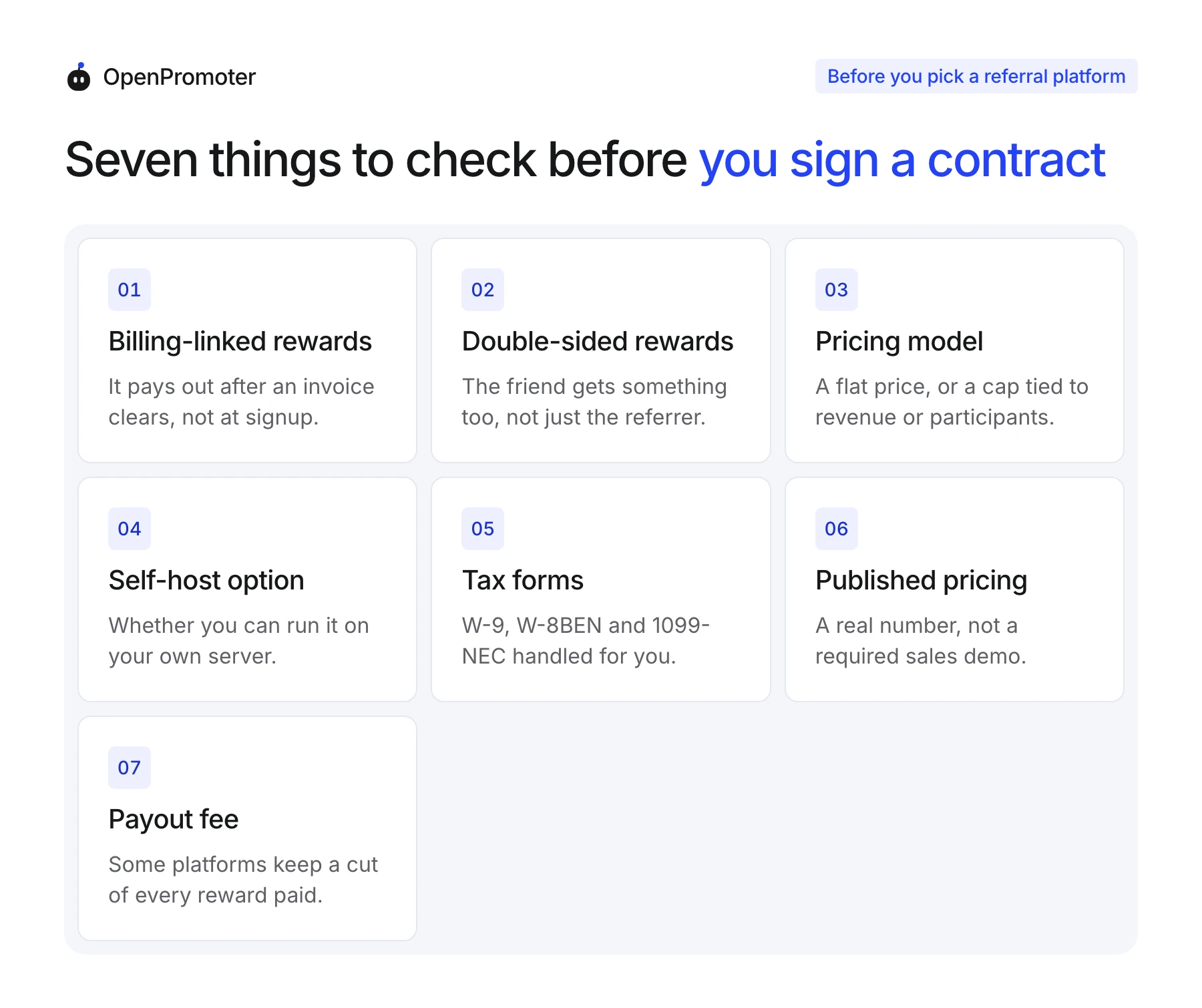
A referral platform earns its price only when it hooks into your billing and rewards the referred customer too. It should also tell you its price before a demo call. The seven checks below are what we scored every tool on, OpenPromoter included.
- Billing-linked rewards: The tool should release a reward only after an invoice is paid. A free trial that never converts should never cost you a payout.
- Double-sided rewards: Many SaaS referral programs give the referred friend a discount too, often through a Stripe coupon set to repeat for a few months. A tool that only pays the referrer misses half the loop.
- Pricing model: Some tools charge a flat monthly price. Others tier by partner revenue or by the number of people in the program, and both can force an upgrade as you grow.
- Self-host option: A handful of referral tools can run on your own server instead of theirs. That matters if you want to own the customer data a referral program collects.
- Tax forms: A reward paid in cash can need a W-9 or a 1099-NEC above the threshold. Software that collects these for you saves a manual process at tax time.
- Published pricing: A page with real numbers lets you compare tools in an afternoon. A tool that only offers a custom quote after a demo takes longer to evaluate.
- Payout fee: A few platforms also keep a cut of every reward paid out. That fee adds up fast once a program is paying real money.
The 8 Best Referral Program Software Tools for SaaS
Eight tools made this list because they publish real pricing or feature pages and can run a referral program for a subscription business. Each one names what we verified, the price as of November 2026, and one real limitation. None are ranked by how much we like them.
1. OpenPromoter
OpenPromoter is open source referral and affiliate software for SaaS that runs one program for customers and outside partners. It reads Stripe, Paddle, Lemon Squeezy, Polar and Chargebee so a reward only books after a real payment. It self-hosts for free or runs as a Cloud plan.
Every plan, including the free one, gives referred customers a double-sided discount. Set it in Settings > Program > Reward for the customer, applied through a Stripe coupon.

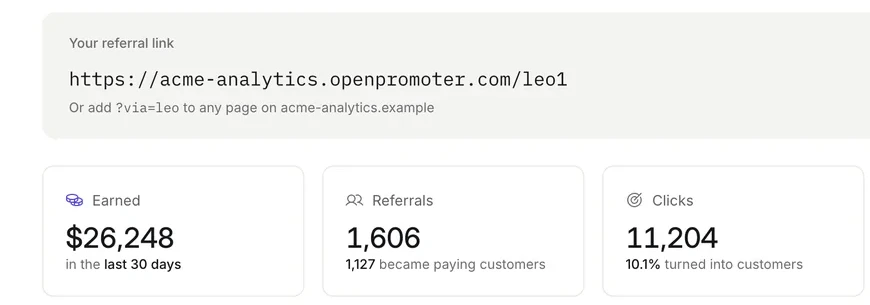
- Key features: Double-sided rewards, fraud checks with an automatic hold, and tax form collection for W-9, W-8BEN and 1099-NEC. It also has a partner portal and a self-host option with no partner limit.
- Pricing: Free to self-host with no revenue cap. The Cloud Free plan covers up to $1,000 a month in partner revenue at $0, and paid Cloud plans start at $29 a month. See the pricing page for the full table.
- Payout fee: 0% on every plan. You pay only the payout rail's own fee.
- One limitation: It is a newer product than most names on this list. It also has no native mobile SDK for an in-app referral screen outside the web embed.
The remaining seven tools are judged on the same checklist, without a screenshot section each, since we only hold real screens of our own product.
- FirstPromoter: Bills itself as referral and affiliate software built for subscription businesses. It connects to five billing providers, including Stripe, Paddle, Chargebee, Recurly and Braintree. Pricing starts at $49 a month for up to $5,000 in monthly affiliate revenue, rising to $99 for $15,000 and $149 above that. Its custom dashboard domain only opens up on the Business tier and above.
- Rewardful: Runs as a Stripe-first referral and affiliate tool built around a flat monthly price. Pricing starts at $49 a month for up to $7,500 in monthly affiliate-attributed revenue, with a stated 0% transaction fee on every plan. It only reads Stripe. A company billing through Paddle or Chargebee needs a different tool.
- Tolt: Covers both affiliate and referral programs, with up to 5 programs on its entry plan. Pricing starts at $99 a month for up to $20,000 in monthly partner revenue. Tolt also keeps 2% of every amount it pays out to a partner on every plan, even on the cheapest tier.
- GrowSurf: Built for SaaS and app referral programs, priced by participants rather than revenue. Its Startup tier starts at $179 a month for up to 2,500 participants. A program with a large free user base can hit that cap fast, well before it earns much revenue.
- Referral Factory: A no-code campaign builder aimed at teams with no engineering time to spare. Pricing starts at $200 a month for 20,000 users, counting referrers and invitees together. A high-traffic program can reach that limit before it reaches 20,000 paying customers.
- Cello: Runs separate plans for customer referrals and a partner marketplace, aimed at product-led SaaS teams. User Referrals starts at $65 a month with a 0% fee, while the free Partner Referrals tier charges 5% of every payout. That free tier carries the highest fee in this comparison.
- PartnerStack: Runs partner recruitment, lead tracking and payouts for B2B SaaS teams with a dedicated partnerships process. Its own pricing page states that the final plan and price are confirmed during a demo. No self-serve price or free trial is listed anywhere on the site.
Referral Program Software Pricing Compared
Entry prices in this category run from free to $200 a month before a single reward is paid. The gap widens once a payout fee is added on top of that. The chart below lines up each tool's starting price against what it keeps from every payout.
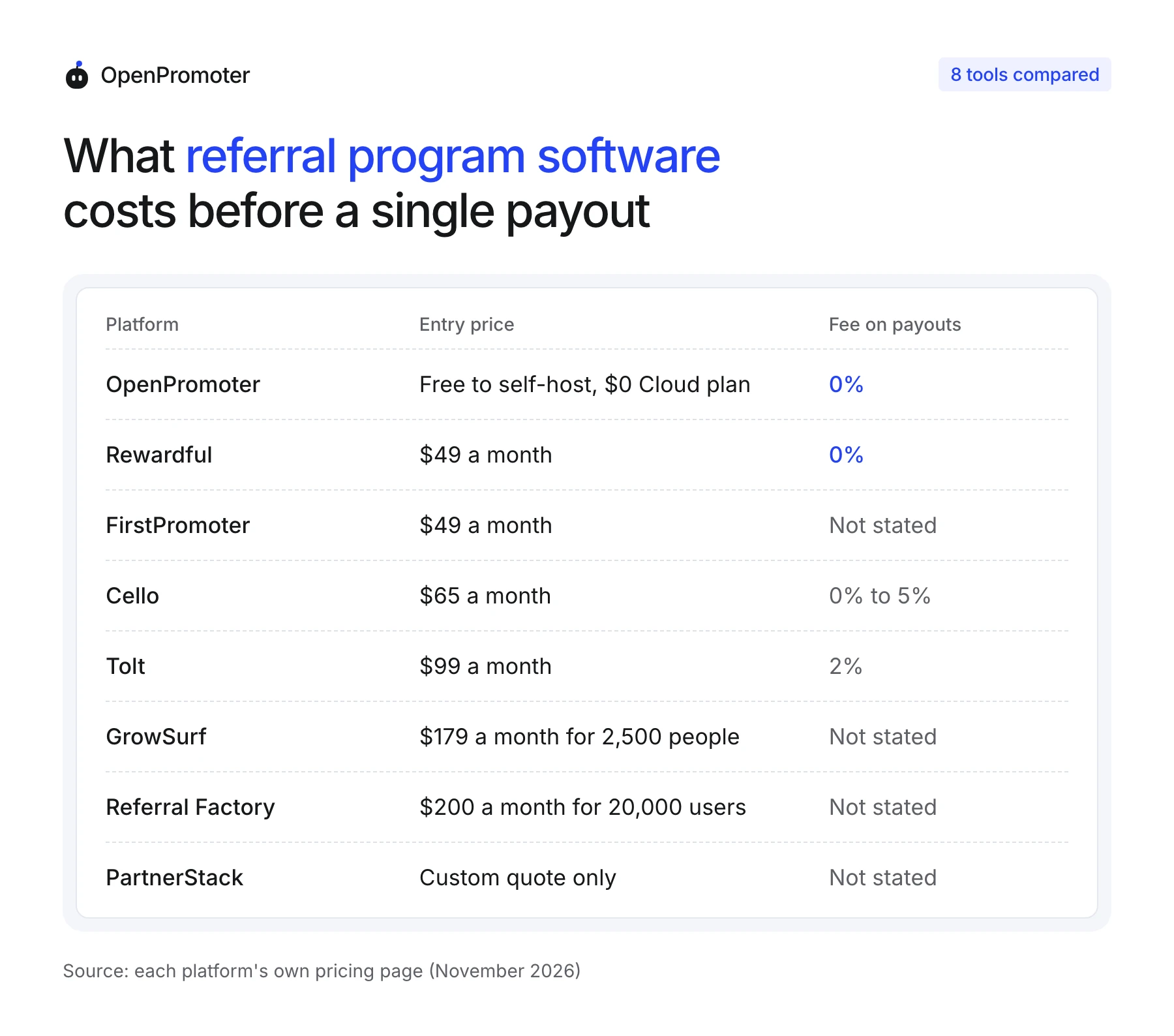
A published flat price is easier to budget than a cap tied to revenue or participants. GrowSurf and Referral Factory price by how many people join the program. A free plan with a large signup base can hit their ceiling before the program earns much at all.
Rewardful and Tolt cap by partner revenue instead of charging one flat fee forever. They only raise the price once the program is already bringing in real money.
Customer referral program software and affiliate software often share one pricing page, because the same link-and-reward mechanics run both. A 2% fee on $50,000 in monthly payouts is $1,000 a month that a 0% tool would never charge. That difference is easy to miss when every tool's homepage leads with the monthly price instead of the fee underneath it.
A tool's own calculator or pricing FAQ is the fastest way to check these numbers before a demo call. Most of the pricing pages linked above state their revenue or participant cap directly, without a login. PartnerStack is the one exception in this comparison.
Referral Program vs Affiliate Program Software
A referral program rewards your own paying customers for inviting a few friends. An affiliate program pays outside partners, such as creators and newsletters, for steady ongoing volume. Most of the eight tools above can run both referral and affiliate programs inside one account.
The practical test is who is sharing the link. A customer sharing with two friends wants a thank-you credit on their next bill. A partner driving fifty signups a month wants a scheduled cash payout and a tax form.
A SaaS team choosing a tool mainly to recruit outside partners has a narrower job than the one this post covers. Our affiliate software alternatives page compares that category directly. Saas referral software and affiliate software overlap enough that most founders end up running both inside one platform.
A SaaS company that already has happy customers usually starts with the referral side first. Outside partners come looking once people talk about the product online.
Running both through one account instead of two separate tools keeps the data about who sent each customer in one place. It also means one invoice instead of two subscriptions to manage every month. A partner who refers often enough can simply move into the affiliate side without losing their history.
A referral program with no outside recruiting still grows through word of mouth alone. An affiliate program with no customer-facing referral option leaves existing fans with nothing to share. Running both covers the gap between people who already pay you and people who do not know you yet.
How to Add a Referral Dashboard to Your SaaS App
A referral program converts better when a customer sees their link and earnings inside the product they already use. Most tools on this list offer an embeddable widget or a hosted portal page for exactly that. Setup usually takes one script tag and one server-side token.
OpenPromoter's own embedded referral dashboard loads as a single <openpromoter-dashboard> tag once your server mints a short-lived token for the signed-in customer. The panel shows the customer's referral link, click count, referred customers and earnings with no separate login. A link to the full partner portal sits at the bottom for anyone who wants more detail.
Rewardful and FirstPromoter also offer embedding, but only on higher-priced tiers. Check that detail before you commit, if an in-app dashboard is the reason you are buying referral software in the first place.
The token behind the embed expires after one hour, and the API key that creates it never reaches the browser. A new token is minted each time the page loads for a signed-in customer.
That keeps the referral link tied to a real account instead of a copyable public URL. Self-hosted teams load the same script from their own server instead of OpenPromoter's.
Conclusion
A SaaS team choosing referral program software is really choosing between two shapes of pricing. A flat, published price with a 0% payout fee keeps the math simple as a program grows.
A tool priced by participants or revenue costs more to evaluate. One that hides its price behind a demo often costs more in both time and money.
Start from the checklist above rather than the name on a homepage. Billing-linked rewards, a double-sided discount and a clear tax process matter more than a long feature list. The right tool is the one that matches how your own program pays people.