
An affiliate marketing platform is software that tracks the sales your partners send and works out what each partner earns. It then pays them and gives each one a portal. Some platforms also bring a marketplace of publishers, and they charge more for it.
This guide uses the public pricing pages of Awin, impact.com, Rewardful and PartnerStack, plus browser and FTC guidance, all checked in November 2026. One thing to know first: we make OpenPromoter, an affiliate platform for SaaS. It gets one section near the end.
You will see the three kinds of platform and what each costs on a worked example. Then come the tracking limits in Safari and Chrome and seven questions that pick the right platform for a SaaS company.
What Is an Affiliate Marketing Platform?
An affiliate marketing platform is the system of record for a partner program. It gives each partner a tracked link and records the clicks and sales that follow. It calculates every commission under your rules, holds it through refunds and pays the partner, who sees the numbers in a portal.
Most platforms cover the same six jobs:
- Tracking: Links, coupon codes and referral IDs tie a customer to a partner.
- Attribution: A rule decides who gets credit when two partners touched one sale.
- Commissions: A percentage or flat amount that can repeat on every renewal.
- Payouts: Batches go out through PayPal, Wise, Stripe or bank transfer.
- Partner portal: Partners sign up there and grab links and assets.
- Fraud checks: Flags catch self-referrals, fake signups and leaked coupons.
For a SaaS company the platform also has to read your billing system. A subscription renews, upgrades and refunds for years. Each of those events changes what a partner is owed.
An affiliate platform that only sees the first order pays the first month and nothing after. That one gap decides more SaaS buying choices than any feature list.
Affiliate Marketing Platforms Come in Three Kinds
Affiliate marketing platforms come in three kinds: networks, partnership platforms and affiliate software. A network rents you its publishers and takes a fee on every sale. Partnership platforms serve larger teams on contracts, while affiliate software runs your own program for a flat price.
| Kind | Example | How it charges | Partner marketplace |
|---|---|---|---|
| Affiliate network | Awin | Monthly fee plus a share of each sale | Yes |
| Partnership platform | impact.com | Plans on a 12-month contract | On Essentials and up |
| Affiliate software | Rewardful and OpenPromoter | Flat monthly price | No |
Networks grew up around retail, coupon and review sites. ShareASale was a second big US network. Awin's March 2025 notice said the ShareASale platform would close by the end of 2025, and its merchants moved to Awin.
Most SaaS programs earn from customers, agencies and writers who already know the product. Affiliate software assumes you find those partners yourself. The guide to how to find affiliates covers where they come from.
Partnership platforms sit between the two. They add a marketplace, contracts and team features for companies with a partner manager on staff.
What an Affiliate Marketing Platform Costs
An affiliate marketing platform costs from $49 a month for flat software to several hundred dollars a month for a network. Networks also add a percentage of every sale on top of the commission you pay. On $20,000 a month in partner sales, that difference comes to about $650 a month.
Here is what each vendor publishes, as of November 2026:
- Awin Access: $99 a month plus a 3.5% tracking fee on each transaction's value. Awin's US pricing page shows a lower price until November 30 and says the partner's commission is paid on top.
- impact.com Starter: $30 a month plus 2.5% of revenue, for stores on Shopify, WooCommerce, BigCommerce and similar platforms. Essentials costs $500 a month, and impact.com's plans page says a 12-month contract is required.
- Rewardful: $49 a month up to $7,500 in affiliate revenue and $149 a month up to $30,000. Its pricing page says it takes 0% of affiliate-attributed revenue.
- PartnerStack: No public prices. Its pricing page says the final price is confirmed during a demo.
Say partners send $20,000 a month in sales and you pay a 20% commission. Partners earn $4,000 a month on every platform. Only the platform's own cost changes:
| Platform | How the fee works | Platform cost per month |
|---|---|---|
| Awin Access | $99 plus 3.5% of $20,000 | $799 |
| impact.com Starter | $30 plus 2.5% of $20,000 | $530 |
| impact.com Essentials | $500 flat on a 12-month contract | $500 plus payout overage |
| Rewardful | Plan for up to $30,000 in affiliate revenue | $149 |
Over a year that is $9,588 on Awin against $1,788 on flat software. The network brings its publishers for that money. The extra $7,800 is worth paying only if those publishers already reach your buyers.
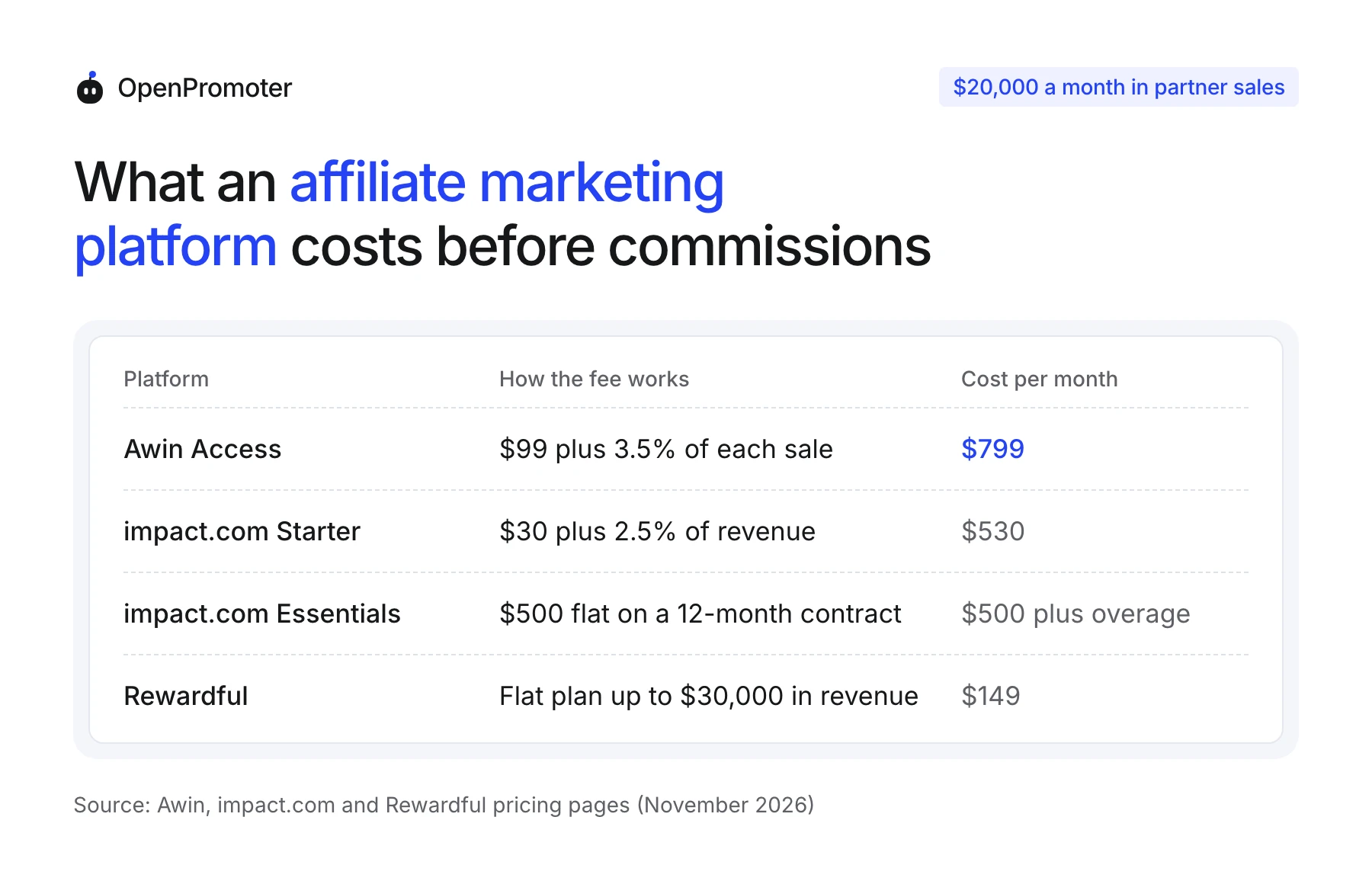
Percentage fees also grow with the program. At $100,000 a month in partner sales, the Awin tracking fee alone is $3,500 a month.
Note: impact.com lists Starter for online stores on platforms such as Shopify. Its plans page says Essentials includes up to $2,500 a month in partner payouts and charges for volume above that. A SaaS company on Stripe should confirm its plan and that overage rate before budgeting.
How Affiliate Tracking Holds Up in Safari and Chrome
Affiliate tracking starts with a cookie that remembers which partner sent a visitor. Safari blocks third-party cookies by default and limits cookies set by scripts, while Chrome still lets people keep them. A platform that also stores the partner in your billing system loses fewer sales to all of this.
WebKit's 2020 announcement says cookies for cross-site resources are blocked by default in Safari. The same post says Safari deletes a site's script-writable storage after seven days of browsing without a visit to that site.
Google planned to remove third-party cookies from Chrome and changed course. Its April 2025 update says users can keep choosing in Chrome's settings. Chrome added no new standalone prompt.
So ask any vendor how its tracking works. Three methods hold up better than a cookie set on a network's domain:
- First-party cookie: A small script on your own domain stores the click. Safari can still clear it after seven days without a return visit.
- Coupon codes: The customer types the partner's code at checkout. No cookie is needed at all.
- Billing-side attribution: The platform saves the partner on the customer record at signup. Every later renewal is credited from billing events.
The affiliate tracking software page shows how the three combine in one setup.
How to Choose an Affiliate Marketing Platform in 7 Questions
Choose an affiliate marketing platform by your billing system first and by price second. Then check tracking, payouts and tax forms on a test sale, and ask who brings the partners. Most vendors answer all seven questions below on their pricing and docs pages.
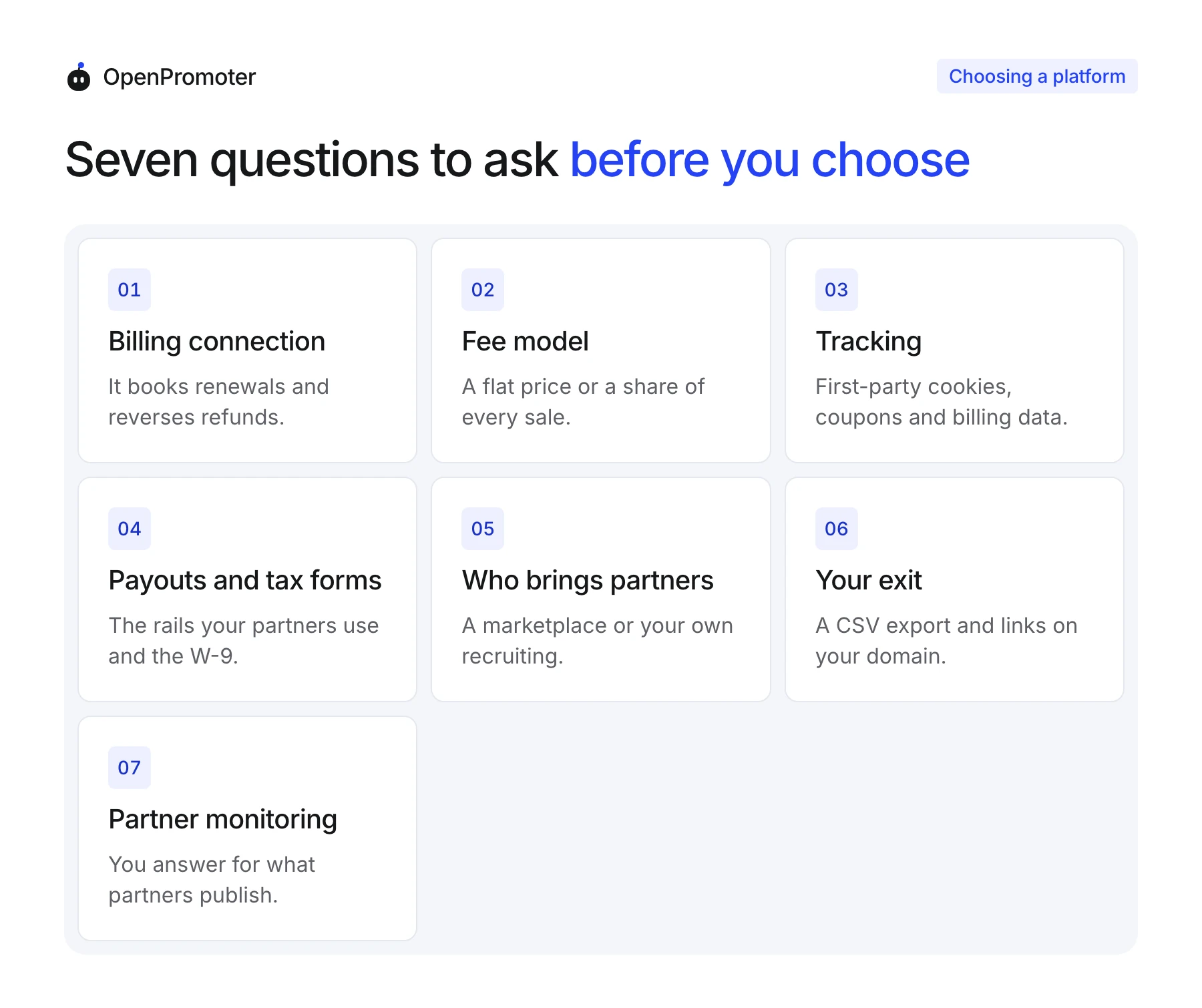
The seven questions in order:
- Billing connection: A SaaS program pays on renewals, upgrades and refunds. Ask whether the platform books a commission on each renewal from Stripe or Paddle and reverses it on a refund. The guide to affiliate commission rates compares recurring and one-time models.
- Fee model: A flat price stays the same as partners sell more. A percentage fee rises with every sale and sits on top of the commission. Run the worked example above with your own revenue for 12 months.
- Tracking without third-party cookies: Look for first-party tracking, coupon codes and billing-side attribution. Click a partner link in Safari and buy with a test card. Check that the sale lands on that partner.
- Payout rails and tax forms: Partners abroad often want Wise or PayPal, and US partners need a W-9 before the 1099-NEC threshold applies. Ask about payout fees too. Rewardful's pricing page lists a 3% processing fee on its optional Managed Payouts.
- Who brings the partners: A network introduces you to publishers you do not know yet. Affiliate software expects you to recruit customers, agencies and writers yourself. Pay for a marketplace only if its publishers already write for your buyers.
- Your exit: Ask for a CSV export of partners, referrals and commissions before you sign. Links on a vendor's own domain stop working when you leave. Ask whether partner links can run on your domain.
- Partner monitoring: The FTC's Endorsement Guides FAQ says delegating your program to an outside company "doesn't relieve you of responsibility under the FTC Act." The platform should show each partner's website and flag risky signups. The guide to preventing affiliate fraud lists the signals worth checking.
What Is the Best Affiliate Marketing Platform?
The best affiliate marketing platform depends on where your partners come from. A retail brand that wants publishers fast often starts on a network such as Awin. A SaaS company that recruits its own customers and agencies usually pays less on flat-priced software, and bigger partner teams look at partnership platforms.
For a SaaS company the shortlist is mostly affiliate software. A side-by-side of those options, with prices and limits, is on our affiliate software alternatives page.
If you are still deciding whether to run a program at all, start with the guide on how to start a SaaS affiliate program. It covers commission, cookie window and terms before any tool.
Where OpenPromoter Fits
We make OpenPromoter, affiliate software for SaaS with flat plans from $0 to $199 a month and no cut of payouts. Weigh this section with that in mind. It books commissions from subscription payments in Stripe, Paddle, Lemon Squeezy, Polar and Chargebee.
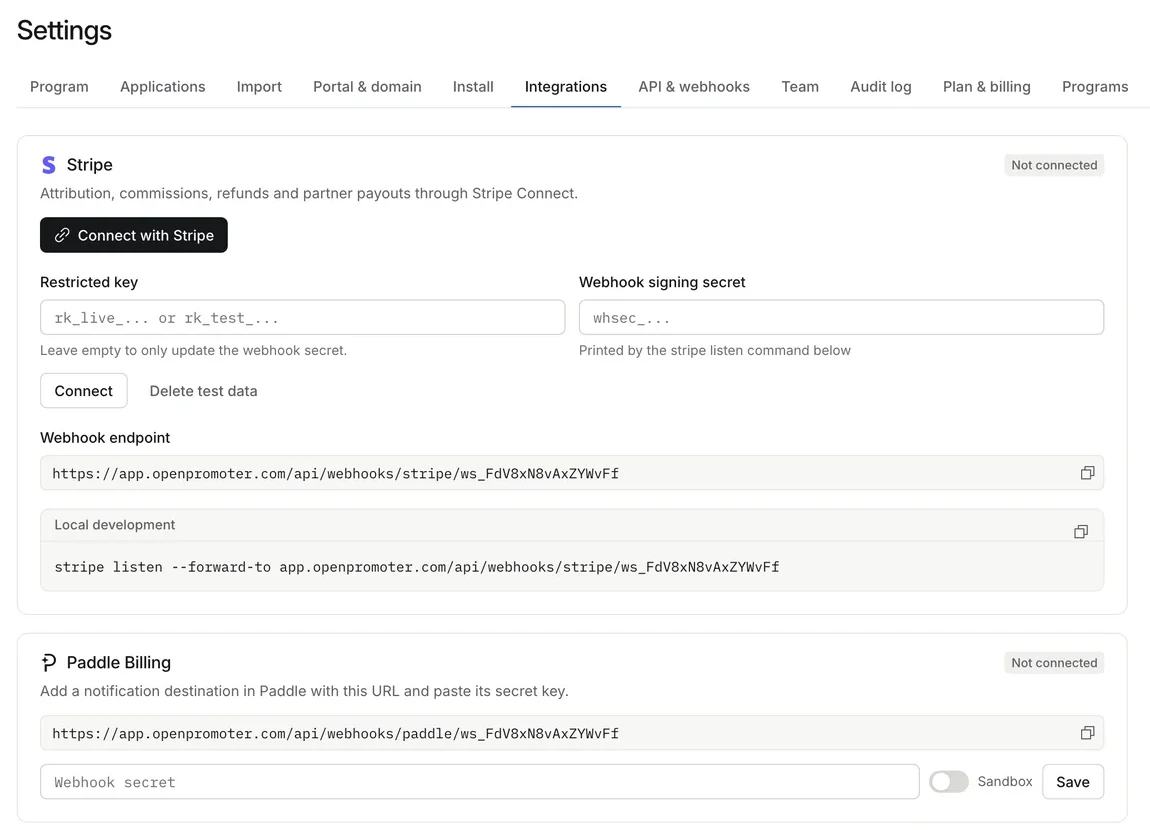
Tracking uses a first-party cookie, coupon codes and the billing customer ID. Once a customer is tied to a partner, every later payment is credited with no time limit. Partners are paid through Stripe Connect, PayPal, Wise or bank transfer, as the affiliate payouts page shows.
It has no marketplace of publishers. You recruit partners yourself, which a network would do for its fee. The code is open source under AGPL-3.0 if you would rather self-host.
Conclusion
An affiliate marketing platform tracks partner sales, calculates commissions and pays partners. Networks charge a share of each sale for access to their publishers. Affiliate software charges a flat price and leaves recruiting to you.
For most SaaS companies the deciding question is the billing system. Pick a platform that reads renewals and refunds from it. Then compare the fee model on your own revenue for a full year.
Test tracking in Safari before launch and check the payout rails and tax forms your partners need. Keep an export path open in case you outgrow the first choice.
Frequently asked questions
Is an affiliate network the same as an affiliate platform?
No. A network such as Awin runs a shared marketplace of publishers and takes a fee on each sale.
Affiliate platforms in the wider sense include software that runs only your own program. Every network is a platform, but most software platforms are not networks.
Can I use more than one affiliate platform at once?
Yes. A network can feed retail publishers while your own software runs the customer and agency program.
Check that the two never credit the same sale. Give each partner one link from one system.
Do affiliate platforms take a cut of commissions?
Some do. Awin adds a tracking fee on each transaction, and impact.com Starter adds 2.5% of revenue. Rewardful says it takes 0% of affiliate revenue but charges 3% on its optional Managed Payouts.
Do I need a platform to start an affiliate program?
You can start with a spreadsheet and manual coupon codes for a handful of partners. Past that, tracking renewals and refunds by hand gets error-prone. A free or low-cost plan usually costs less than the mistakes.
Can I move my affiliates to a new platform?
Yes. Export partners and their balances and invite them to the new portal.
OpenPromoter also reads the ?via=, ?fpr=, ?ref= and ?gspk= parameters other tools use. A partner's old link to your site keeps earning after the move.
Is there a free affiliate marketing platform?
A few have free plans or trials. Rewardful offers a 14-day trial on every plan. OpenPromoter's Free plan covers up to $1,000 a month in partner revenue with every feature, and self-hosting is free.