
The short answer to how to find affiliates for a SaaS product is to start with people who already pay you. After them come the integration partners, agencies and creators your buyers already trust. Communities and marketplaces come last because they mostly reach strangers.
This plan comes from the OpenPromoter recruiting code and docs, plus FTC guidance and Google's search help, all checked in November 2026. One thing to know first: we make OpenPromoter. So the plan works with any affiliate tool, and our own product gets one section near the end.
You get the six sources in order, with where to look for each and search strings you can paste into Google. Then come a short outreach email, a vetting checklist that screens for fraud and a 30 day plan to get new partners posting.
How to Find Affiliates: The Order That Works for SaaS
Learning how to find affiliates for SaaS starts with the order you search in. Paying customers come first, with integration partners and agencies right behind them. Creators in your niche follow, and communities and marketplaces come last because they reach people who have never used your product.
The order follows two questions. Does this person already trust the product, and do they already reach people who buy software like yours?
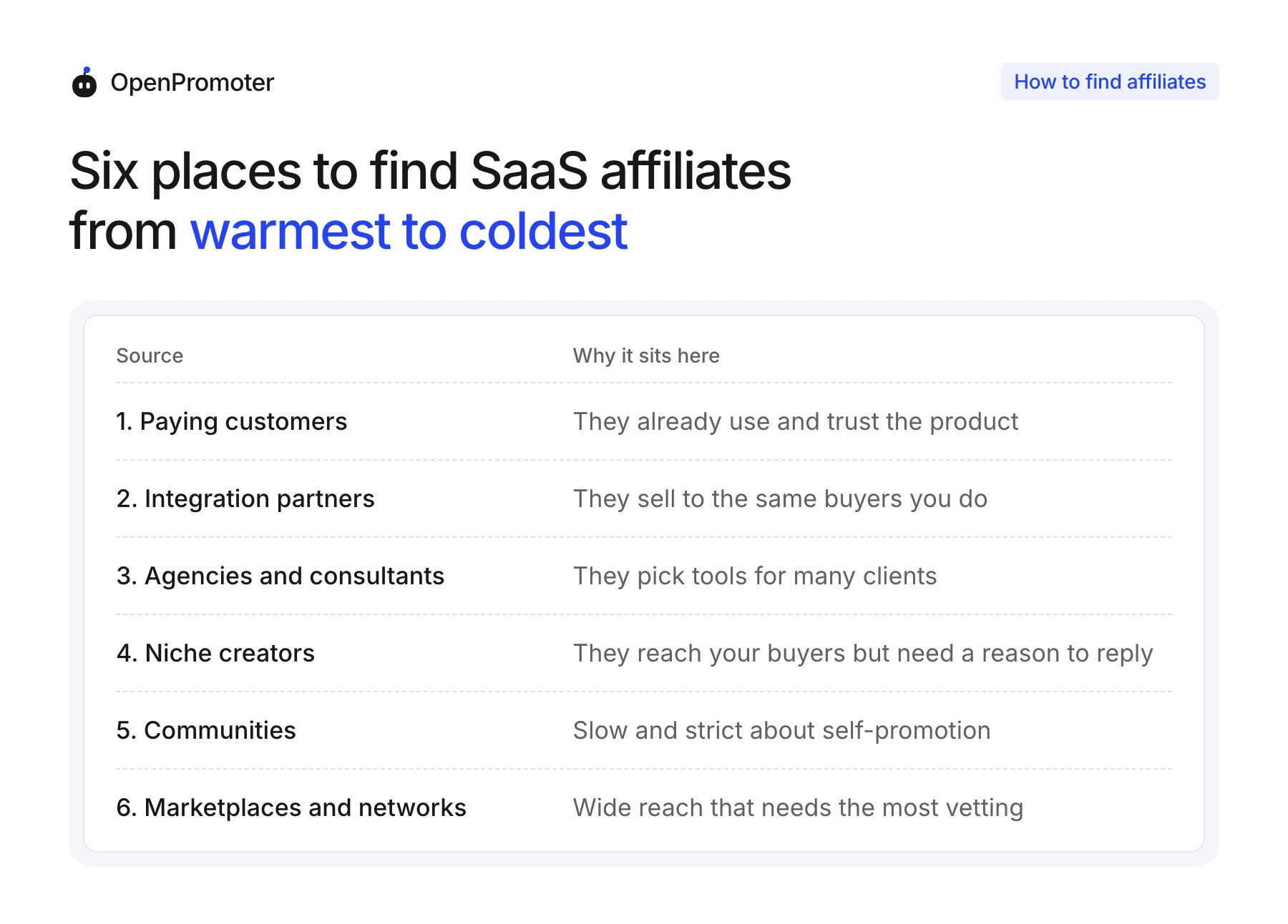
Here are the six sources, from warmest to coldest:
- Paying customers: They know the product and their praise is honest. Their colleagues and friends often share the same job and the same problem.
- Integration partners: Tools your customers connect to yours already sell to your buyers. A partner page or a shared guide puts you in front of their users.
- Agencies and consultants: People who set up software for clients recommend tools as part of the job. One agency can bring several client accounts in a year.
- Niche creators: Newsletters, YouTube channels and bloggers who write for your buyers have the reach. They do not know you yet and need a reason to reply.
- Communities: Slack groups, forums and subreddits where buyers ask for advice. They work slowly and punish anyone who arrives only to promote.
- Marketplaces and networks: Partners browse many programs there at once. Expect deal and coupon sites in the mix and vet every application.
Customers who arrive through other customers tend to be worth more. A 2011 Journal of Marketing study of about 10,000 German bank customers found referred ones at least 16% more valuable than similar customers acquired otherwise.
The authors note that the gap varies across customer segments, and a bank is not a software company. Still, the finding supports asking your happiest customers before you ask strangers.
Good affiliate recruitment for SaaS follows this order for a practical reason as well. You can reach the first three sources today by email without any searching.
Start With Your Own Paying Customers
Your own paying customers make the best first affiliates because they already use the product and can describe it honestly. Pick the ones who have paid the longest, spend the most and still subscribe. Invite five to ten of them personally before you look anywhere else.
Three signals mark a customer worth asking. Tenure shows they stayed through renewals. Lifetime value shows the product matters to their budget, and an active plan shows they still use it.
Add a fourth signal you can only find by reading. Look for customers who praised you in a support thread, left a review or answered a question about you in a community.
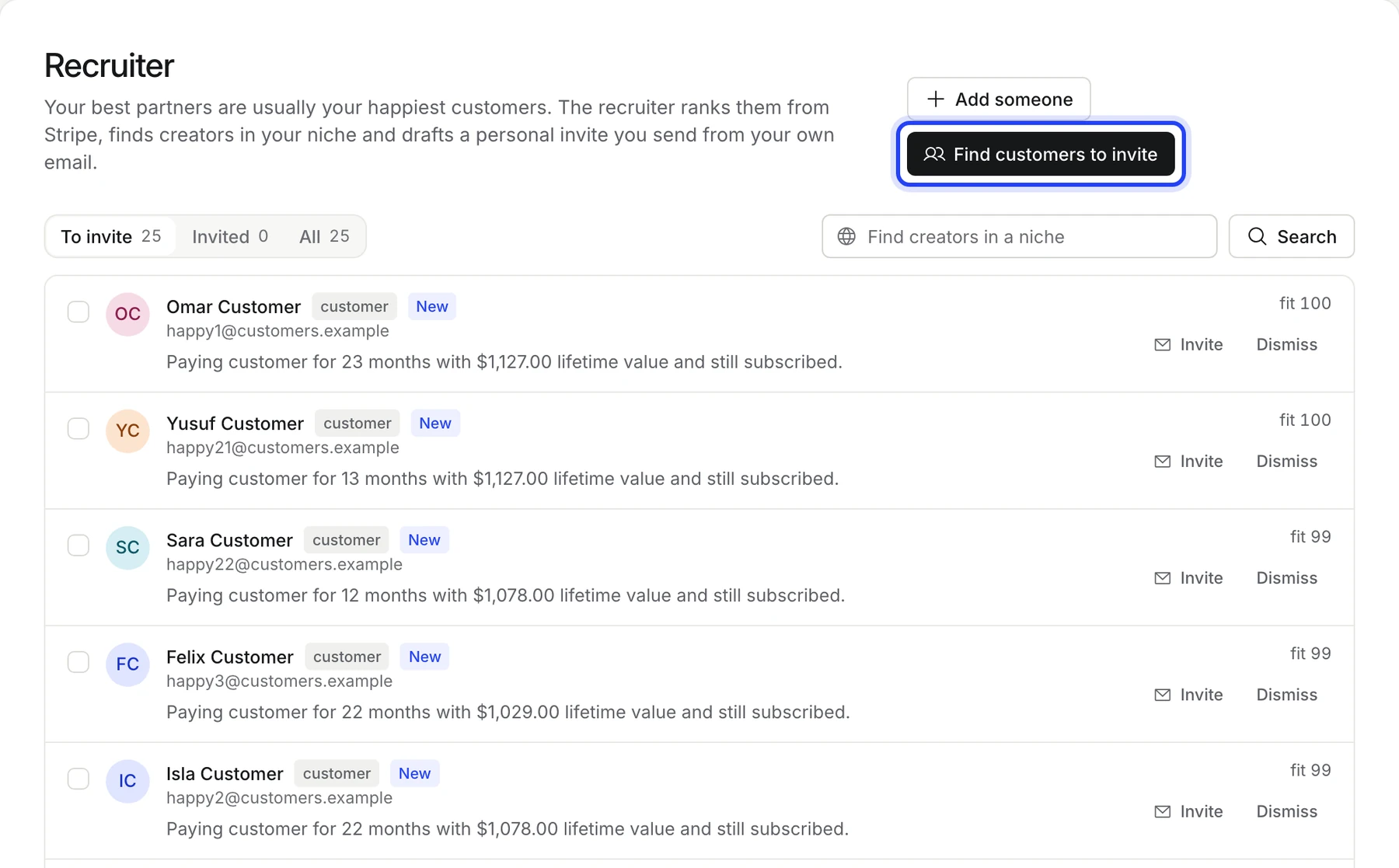
The OpenPromoter Recruiter ranks paying customers by how long they have paid, their lifetime value and whether they still subscribe. It adds up to 25 of them to a list with a drafted invite for each and skips anyone who is already a partner.
Edit each invite so it names the feature that person uses most. A note that reads like a template gets ignored, and a customer who feels singled out for a good reason usually answers.
Some customers will want a discount on their own plan more than cash. Those people fit a SaaS referral program better than an affiliate program, and nothing stops you from running both side by side.
Find Integration and Agency Partners
Integration partners and agencies are the second place to look for SaaS affiliates. Integration partners sell tools your customers already connect to yours, and agencies set up software for clients for a living. Both reach your buyers at the exact moment those buyers choose new tools.
Start with the integrations your customers turn on most. The companies behind them already sell to the same people, and a joint guide or a partner listing gives both of you new customers.
Then look at the app marketplaces and integration directories where your product is listed. Other apps in your category there make natural partners when they do a different job from yours.
An integration partner rarely cares about a commission on its own. Offer a two-way deal: each of you lists the other, and both earn on the customers you send across.
Agencies and freelance consultants are the other half of this source. Say an agency sets up analytics for 20 clients a year. If it recommends you to a quarter of them, that is five paying accounts from one partner.
Find agencies in your own customer list first. Look for customer emails on agency domains and for accounts that manage several workspaces or client projects.
Agency partners may value recurring commission, a partner badge or early access to new features. Ask what matters to them before you pitch a rate, and shape the offer around the answer.
How to Find Affiliate Marketers Who Write for Your Buyers
To find affiliate marketers for a SaaS product, look for people who already publish for your buyers. Newsletters, YouTube channels and blogs that review tools in your category are the best fit. Google search operators find them in minutes, and their own pages show who they reach.
The strongest sign is a page that already compares tools like yours. A writer who published a "best tools" list or an "alternatives" post ranks for buyers who are choosing software now.
Google's search operators help page documents the few you need. Quotes match an exact phrase, and site: limits results to one site. A minus sign leaves a word out, and after: finds pages updated after a date.
Swap in your category and your biggest competitor before you run each line:
"[competitor] alternatives" -site:[competitor].com
"[competitor] vs" -site:[competitor].com
"best [category] tools" after:2025
site:youtube.com "[category]" review
site:substack.com "[category]"
"[category]" newsletter sponsor
Each result is a possible partner, and their page tells you most of what you need. Check the date, whether they already use affiliate links and how they disclose them.
Judge each one in about two minutes. Look for posts in the last 90 days, replies from real readers and a topic that matches the person who buys your product.
Creators who review your competitors are the warmest of your cold contacts. They already earn from software in your category, and adding one more program is a small decision for them.
Keep a list as you go with the name, the link, the contact address and one line on why they fit. That line becomes the first sentence of your outreach email.
Communities, Marketplaces and Your Own Site
Communities, partner marketplaces and your own website find affiliates who come to you. They take longer than direct outreach and bring a wider mix of partners and promotion styles. Use them after the first three sources, and vet everyone who applies through them.
In communities, answer questions first and mention the program only where the rules allow it. Many Slack groups and subreddits ban self-promotion, and one deleted post can cost you the whole room.
Partner marketplaces and affiliate networks list your program where partners browse. You meet people who already promote software, along with coupon and deal sites that may not fit a subscription product.
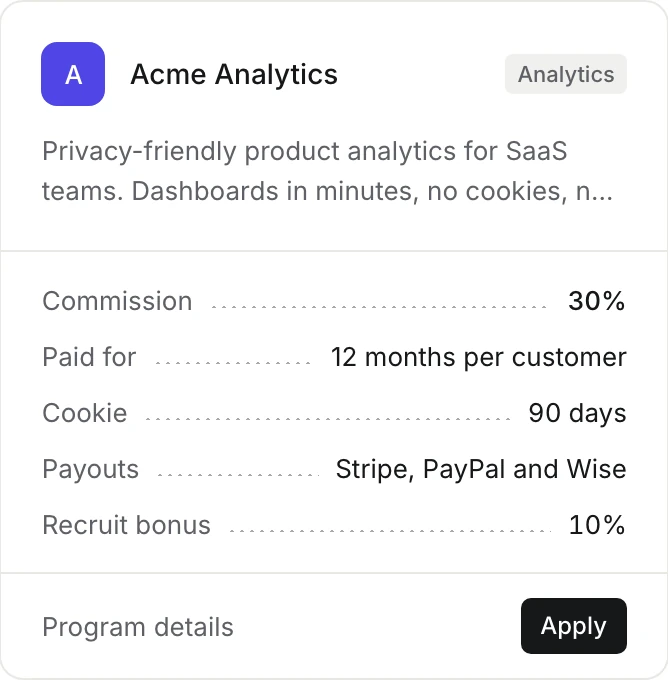
OpenPromoter lists public programs in its partner marketplace once you switch the listing on. Each listing shows the rate, how long it pays, the cookie window and the payout methods you allow.
Your own site is the cheapest channel of all. Add a Partners link to your footer and to your pricing page. Point it at a program page that states the rate, the cookie window and the payout terms.
How to Recruit Affiliates With a Short Outreach Email
To recruit affiliates, send a short personal email from your own address. Say why you picked them, state the offer in one line and include one link to your program page. Follow up once after about four days and stop there if nobody answers.
These five rules cover what goes into the email:
- Name why them: Point to a post, a video or how they use your product. One true sentence beats a paragraph of praise.
- State the offer in one line: Give the rate, how long it pays and the cookie window. Partners compare programs on these three numbers.
- Send one link: Link the program page or the apply page. Two links split attention and make the email look like a newsletter.
- Send from your own address: A reply should reach you directly. A founder's name in the inbox reads as a person writing to them.
- Follow up once: One short reply in the same thread after a few days is enough. More than that reads as pressure.
Here is an example for a creator who reviewed a competitor. Edit every bracket before you send it:
Subject: Your [competitor] review and a partner offer

Hi [first name],

I read your [competitor] review last week. The part about [specific point]
is the exact problem [your product] solves for [type of customer].

We run a partner program: [30%] of every payment from people you refer,
for [12 months], with a [90 day] cookie. If you want to try the product
first, I will set up a free account for you.

Here is the program page: [link]

Thanks,
[Your name], founder of [your product]
[Your postal address]
Reply "no thanks" and I won't write again.
A cold partner pitch is still a commercial email. The FTC's CAN-SPAM compliance guide states that "the law makes no exception for business-to-business email."
The same guide asks for honest headers and subject lines and a clear sign the message is an ad. It also asks for your postal address and a way to opt out.
The example names the partner offer in the subject and ends with an address and a one-line opt-out. Treat this as general information and not legal advice.
Track every invite in one place so nobody gets a second first email. A sheet with the name, source, date sent and reply is enough while you learn how to recruit affiliates.
How to Vet Affiliates Before You Approve Them
Vet every affiliate before approval by checking their site, their audience and how they plan to promote you. Screen for fraud risk at the same time, such as disposable emails, coupon sites and plans to bid on your brand. Approving slowly at first is cheaper than reversing commissions later.
Use this checklist when recruiting affiliates, whether they applied or you invited them:
- A real site or channel: It loads, has recent posts and matches the name on the application.
- An audience that buys software: Readers or viewers who run a business or a team, in a niche close to yours.
- A stated promotion plan: Ask how they will promote you. Reviews and tutorials are good answers. Coupon pages are a warning.
- No brand bidding: Partners who buy ads on your product name earn on customers who were already searching for you.
- An email that is not disposable: A throwaway address makes the partner hard to reach and a second account easy to hide.
- A payout method you support: Check the country and the payout method before the first sale arrives.
OpenPromoter can approve clean applications on its own. With auto-approve on, an applicant whose risk score is above 40 waits for you, and a disposable email alone pushes the score past 40.
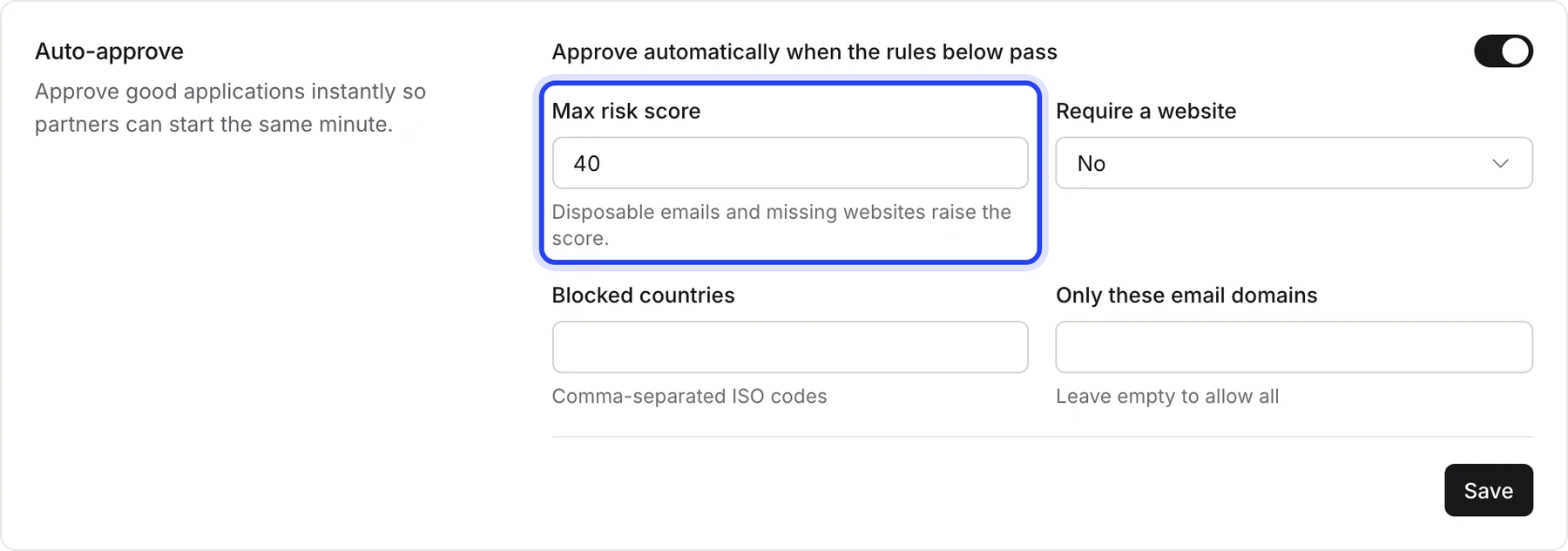
The application form docs list the other rules, such as requiring a website or allowing only certain email domains. You can also add your own questions, like how the applicant plans to promote you.
Write the rules into the terms partners accept when they join. An affiliate agreement template shows the clauses on self-referral, brand bidding and coupon sites. The guide on how to prevent affiliate fraud covers the payout rules that catch what vetting misses.
What to Offer New Partners
Offer new partners a commission rate you can afford for as long as the customer pays. Add a cookie window longer than your free trial, and give referred customers a discount. A bonus on the first sale gives a new partner a reason to post this month.
Pick the rate from your own margins and churn. Our guide to SaaS affiliate commission rates shows what real programs pay and how to choose from your own numbers.
Write the offer as one line partners can repeat. An example line such as "30% of every payment for 12 months with a 90 day cookie" fits in a social post.
How to Onboard Your First 20 Partners So They Post
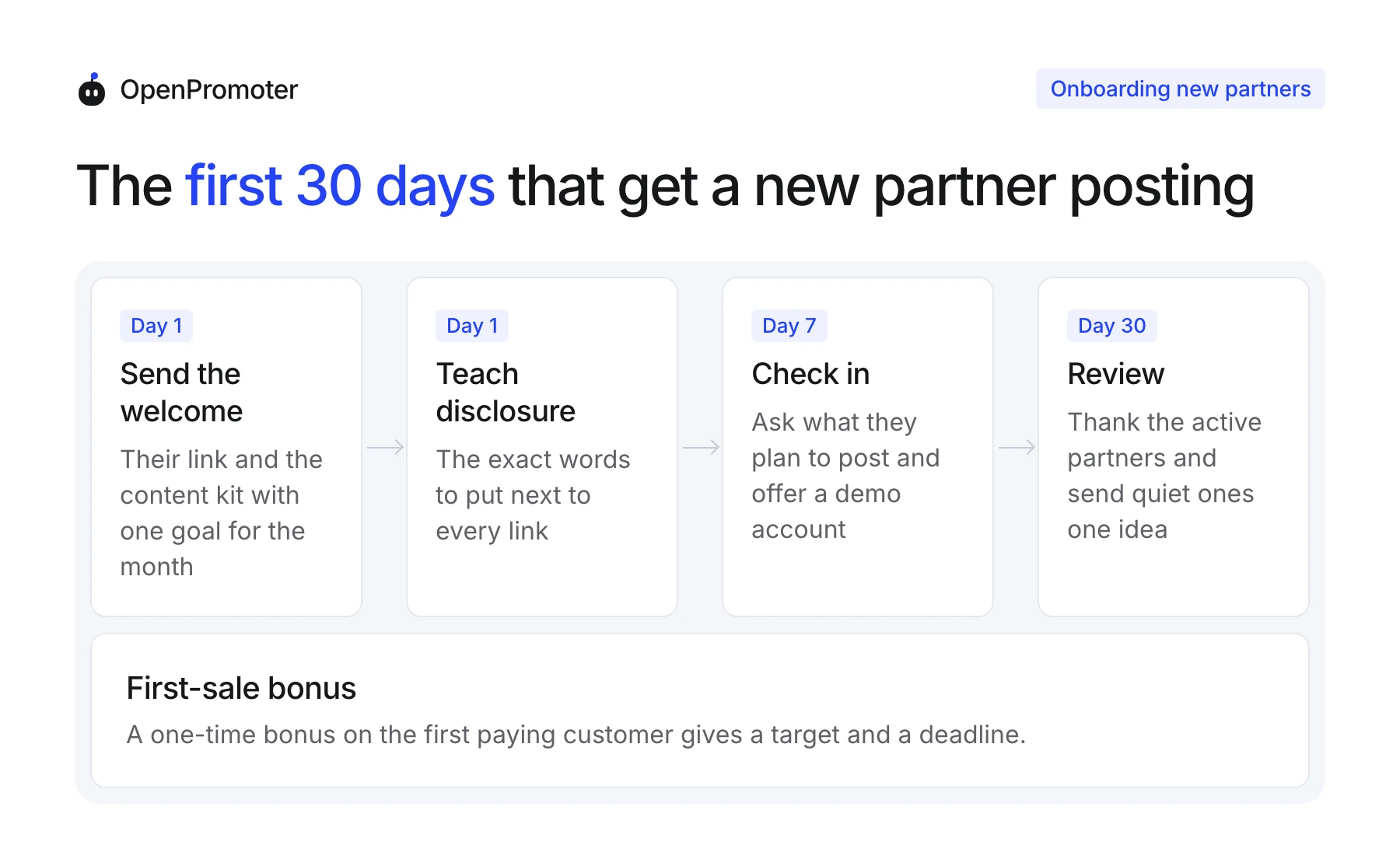
Onboard new partners within a day of approval with their link, ready-made posts and one first goal. Teach them to disclose the relationship on day one. Check in at day 7 and day 30 to help the partners who have not posted yet.
A new partner who has to write from scratch tends to put it off. Hand them something they can post today and a reason to do it this month.
Work through these steps with every new partner:
- Send the welcome: On day 1, send their link, a coupon code if you use them and a partner content kit with posts, emails and banners. Name one small goal like one post this month.
- Teach disclosure: Show the exact words to put next to their link. Ask them to use it in every post and video description.
- Set a first-sale bonus: A one-time bonus on the first paying customer gives the partner a target and a deadline.
- Check in on day 7: Ask what they plan to post. Offer a demo account, a screenshot or a quote they can use.
- Review on day 30: Thank the partners who sent clicks. Send the quiet ones one fresh idea, and stop chasing after that.
The FTC's Endorsement Guides FAQ says "Paid link" next to an affiliate link "should be an adequate disclosure." It warns that "Affiliate link" alone may not be clear to shoppers.
The same page says advertisers "need to have reasonable programs in place to train and monitor members of their network." The day 1 disclosure step and the day 30 review are that program in a small form.
How OpenPromoter Helps You Find Affiliates
OpenPromoter helps you find affiliates with a Recruiter that ranks your paying customers and drafts an invite for each. It can also search the web for creators in your niche. Every invite goes out from your own Gmail or mail app, and OpenPromoter never emails your prospects.
Click Find customers to invite and the Recruiter adds up to 25 customers from your connected billing provider. Type a niche such as product analytics newsletters to run creator search. It adds up to 10 creators, newsletters, YouTube channels or blogs, each with a reason and a fit score.
Creator search uses AI with web search and keeps only people found on real pages. Without an AI key, customer ranking still works, invites use a template and you add creators by hand with Add someone.
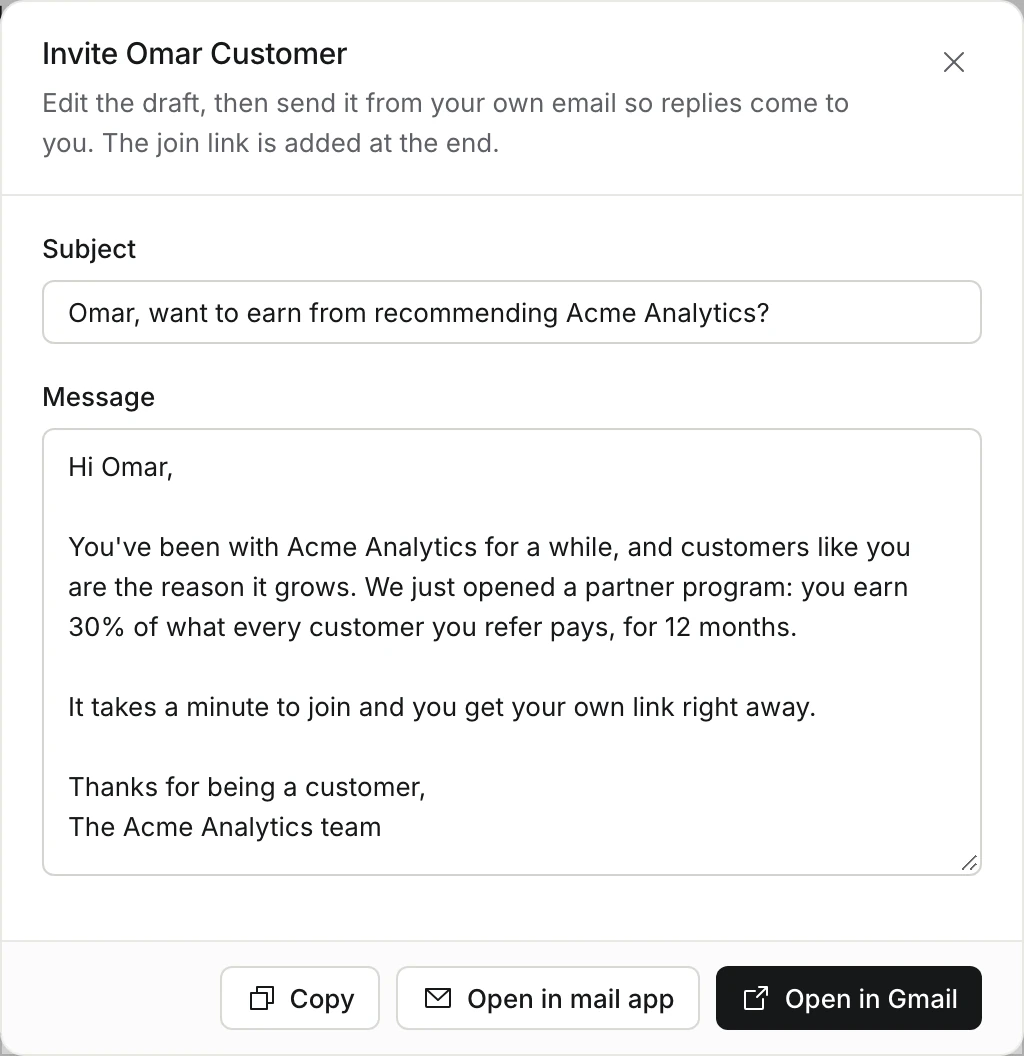
Open in Gmail or Open in mail app opens the draft addressed to the prospect with the join link at the end. You click send yourself, and replies reach you directly. Autopilot and the AI never send invites.
Two more channels sit in the same app. A marketplace listing puts your program where partners browse, and a recruiter override gives each partner a recruit link for bringing in others. The recruiting docs walk through each step.
Conclusion
The plan for how to find affiliates in SaaS starts with the people who already pay you. Integration partners and agencies come next. Creators follow, and communities and marketplaces come last because they reach strangers.
Keep the outreach email short and send it from your own address with one link and one follow-up. Vet every applicant for fraud risk before approval, and hand new partners a kit and one goal on day one.
If your program is not live yet, start with the guide to starting a SaaS affiliate program. Then come back to this list and send your first five invites this week.
Frequently asked questions
How many affiliates does a SaaS program need?
No public study we could verify sets a number for SaaS programs. Start with five to ten partners you know well and learn from their first month. Add more once your terms, tracking and content kit work for those first partners.
Where can I find affiliates for free?
Your customer list, your integration partners and Google searches with operators cost nothing but time. Communities and a Partners link in your footer are free too. Paid networks and recruiting services make sense once the free sources stop producing replies.
How to get affiliates for a new product with few customers?
Start with people you already know, such as early users, beta testers and founders in your network. Next, reach creators who review your competitors and offer them a free account to try the product first. A higher rate for the first months can make a small product worth their time.
Is it legal to cold email potential affiliates?
In the US it is legal when the email follows the CAN-SPAM Act. The FTC compliance guide asks for honest subject lines, your postal address and a working opt-out. Rules differ in other countries and are worth checking before you write to partners abroad.
Should you join an affiliate network?
A network puts your program in front of partners who already browse offers. It also brings coupon and deal sites and may charge a fee on each sale or payout. Join one after your own sources are running, and vet each partner it sends.
Should you pay affiliates a flat fee to post?
A flat fee pays for the post whether or not anyone buys. Commission pays only when a referred customer pays you. For a creator you trust, a small fee plus commission can work, and a first-sale bonus is a middle path.
How long until the first affiliate sale?
The first sale cannot arrive before a referred trial ends and converts. With a 14 day trial and a partner who posts on day 14, the first paid invoice lands around day 28. Track posts and clicks until then.