
An affiliate agreement template is the contract your partners accept before they promote your product. It sets what they earn, when they get paid and what they may never do. A SaaS program also needs clauses for recurring commissions, refund holds and clawbacks, and generic templates often leave those out.
We built this guide in November 2026 from the FTC's Endorsement Guides, Google's ad policy, Stripe's dispute rules and the OpenPromoter code. One thing to know first: we make OpenPromoter. The guide is general information and is not legal advice, and a lawyer should review your final version.
You get a clause-by-clause guide written for recurring revenue, with a worked example of a refund that lands after payout. Then comes one complete template to copy. The last sections show how to sign and store it and which mistakes make terms hard to enforce.
What Is an Affiliate Agreement?
An affiliate agreement is the contract between your company and the partners who promote it for a commission. It defines what counts as a sale, how much the partner earns and which ways of promoting you are banned. In a SaaS program it often lives on the program page as terms partners accept when applying.
The same document goes by several names in search results and in legal template libraries. An affiliate marketing agreement, an affiliate marketing contract and affiliate program terms and conditions all describe it.
A deal with one large creator or agency may use a long contract that both sides sign. A program with dozens of self-serve partners tends to use click-accept terms, because nobody wants to sign a PDF for a 30% referral fee.
The agreement protects you as much as the partner. Under the FTC's Endorsement Guides, advertisers are subject to liability for misleading statements made through endorsements. The same section covers a failure to disclose unexpected material connections with endorsers.
So a partner's misleading post can become your problem. The agreement is where you write down the rules every partner follows and what happens when one breaks them.
If you have not picked a rate or a cookie window yet, the guide to starting a SaaS affiliate program covers those choices first. Come back here once the numbers are set, because every clause below repeats them.
What an Affiliate Agreement Template Should Cover
The affiliate agreement template in this guide has 18 clauses, from who may join to which law applies. Eight of them carry the SaaS rules about recurring pay, refunds, tax forms, brand ads and disclosure. The rest are standard contract parts that most free templates already include in some form.
Here is every clause in the template and the question each one settles:
| Clause | What it settles |
|---|---|
| 1. Joining the program | Who may apply and your right to refuse anyone |
| 2. Relationship | Partners are independent and the deal is non-exclusive |
| 3. Commissions | The rate and how many months each customer pays |
| 4. Attribution | Cookie window, first or last click and coupon codes |
| 5. Hold period | How long commissions stay pending |
| 6. Refunds and clawbacks | What a refund or chargeback does to a commission |
| 7. Payouts | Schedule, minimum, methods and fees |
| 8. Taxes | Tax forms before payout and who pays the tax |
| 9. Prohibited promotion | Self-referral, fake accounts, spam and false claims |
| 10. Coupon codes | Where partner codes may appear |
| 11. Paid search | Bidding on your brand name and domain |
| 12. Disclosure | How partners tell readers they earn a commission |
| 13. Brand use | Your name, logo and approved materials |
| 14. Fraud review | Your right to hold and reverse commissions |
| 15. Changes | Notice before rates or rules change |
| 16. Termination | How either side ends it and what is still paid |
| 17. Liability | Indemnity and limits of liability |
| 18. General | Governing law and the whole agreement |
Clauses 3 to 12 are business rules you know better than any lawyer. Clauses 17 and 18 are where a lawyer earns their fee, because they depend on where your company is based.
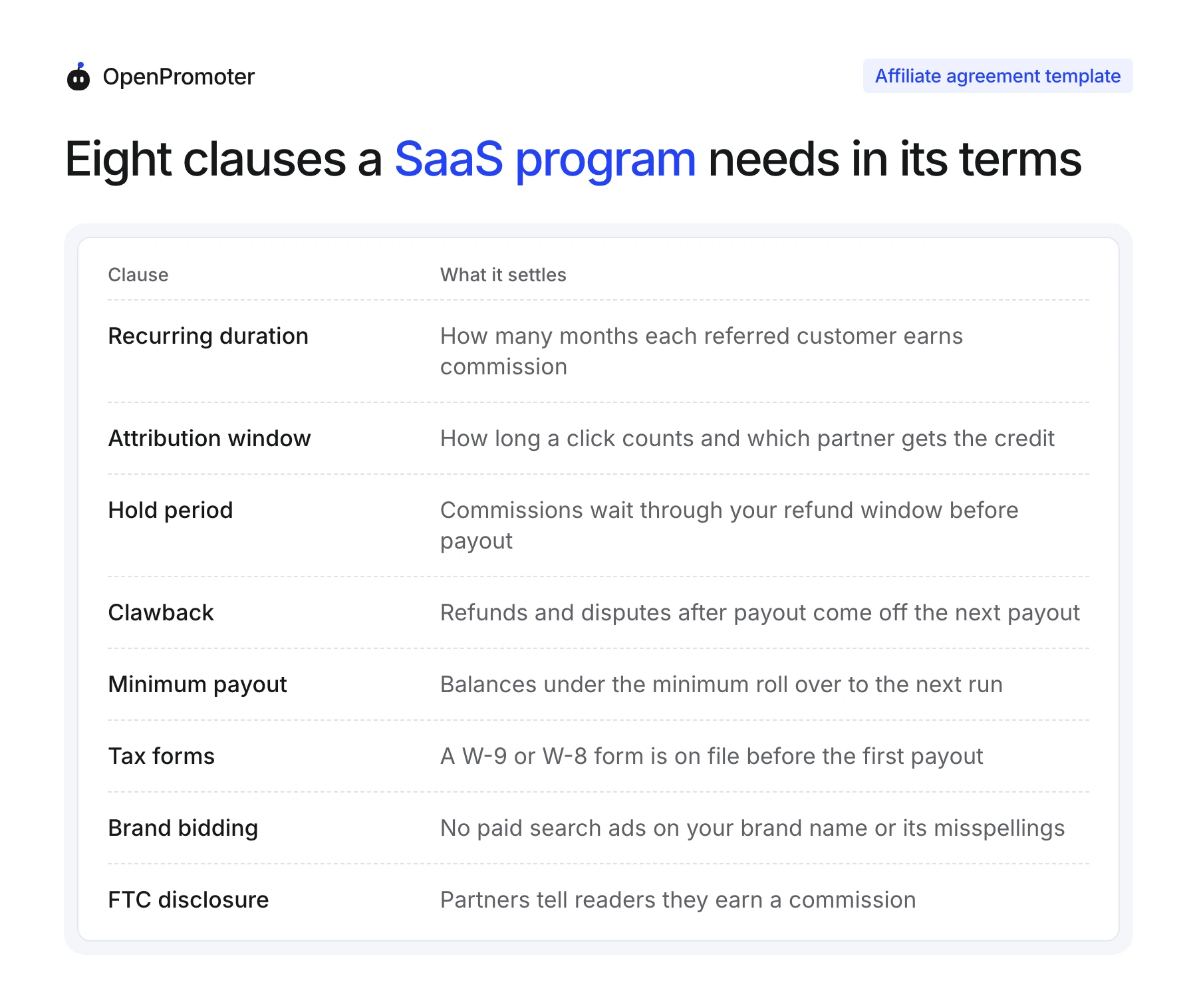
Several free templates we read in November 2026 had no clause for recurring duration, the hold period or brand bidding. Those three are where a subscription program differs most from a one-time sale.
Read the table as a checklist against your own settings. Every number in clauses 3 to 7 should match what your affiliate tool does, since partners will quote the terms back to you.
Commission Clauses for Recurring SaaS Revenue
Commission clauses in a SaaS affiliate agreement say what earns money, for how many months and when it can be paid. They should tie the hold period to your refund window and allow clawbacks after payout. A minimum payout and a tax form rule complete the money side of the agreement.
Write each of these as its own numbered clause:
- Qualifying payment: Commission is earned on money the referred customer pays, after discounts and before tax. Trials, signups and checkout visits earn nothing unless you offer a separate lead reward.
- Recurring duration: Say whether you pay on the first payment only, for a set number of months or for the customer's lifetime. Count the months from the customer's first payment so nobody argues about the start date.
- Attribution window: State how long a click counts and whether the first or the last partner click gets the credit. A coupon code tied to one partner should credit that partner with or without a click.
- Hold period: Keep each commission pending for at least as long as your refund policy runs. A 30 day refund promise needs a hold of 30 days or more.
- Clawback: Refunds and lost disputes that land after payout come off the partner's next payout. Say it plainly. Partners read a surprise deduction as bad faith.
- Minimum payout: Balances under the minimum roll over to the next payout run. Name the amount and the currency in the clause.
- Tax forms: Partners give a valid tax form before their first payout and pay their own taxes. US partners give a W-9, and partners outside the US give a W-8BEN or W-8BEN-E.
The clawback clause matters because refunds are not the only late event. Stripe says card networks usually let cardholders open a dispute within 120 days of the original payment. When that happens, Stripe debits the disputed amount plus a dispute fee from your account.
The tax form rule has a source too. The IRS says to use Form W-9 to give your correct taxpayer identification number to the person who files an information return. The 1099-NEC threshold for 2026 then decides which US partners need a form at year end.
Here is how the clauses work together in a worked example. Say your plan costs $49 a month and you pay partners 30% for 12 months. The partner earns $14.70 on each invoice, or $176.40 over the year.
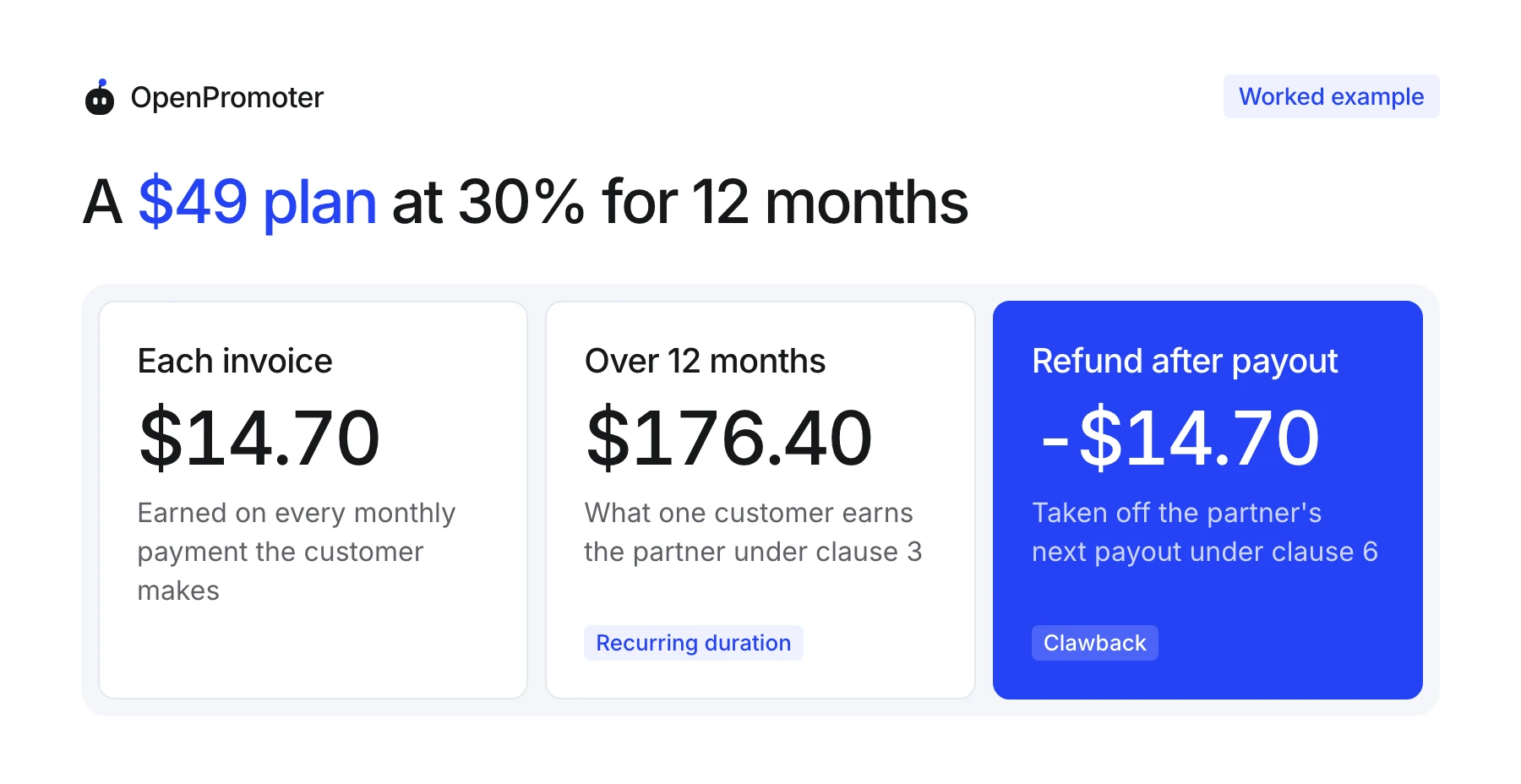
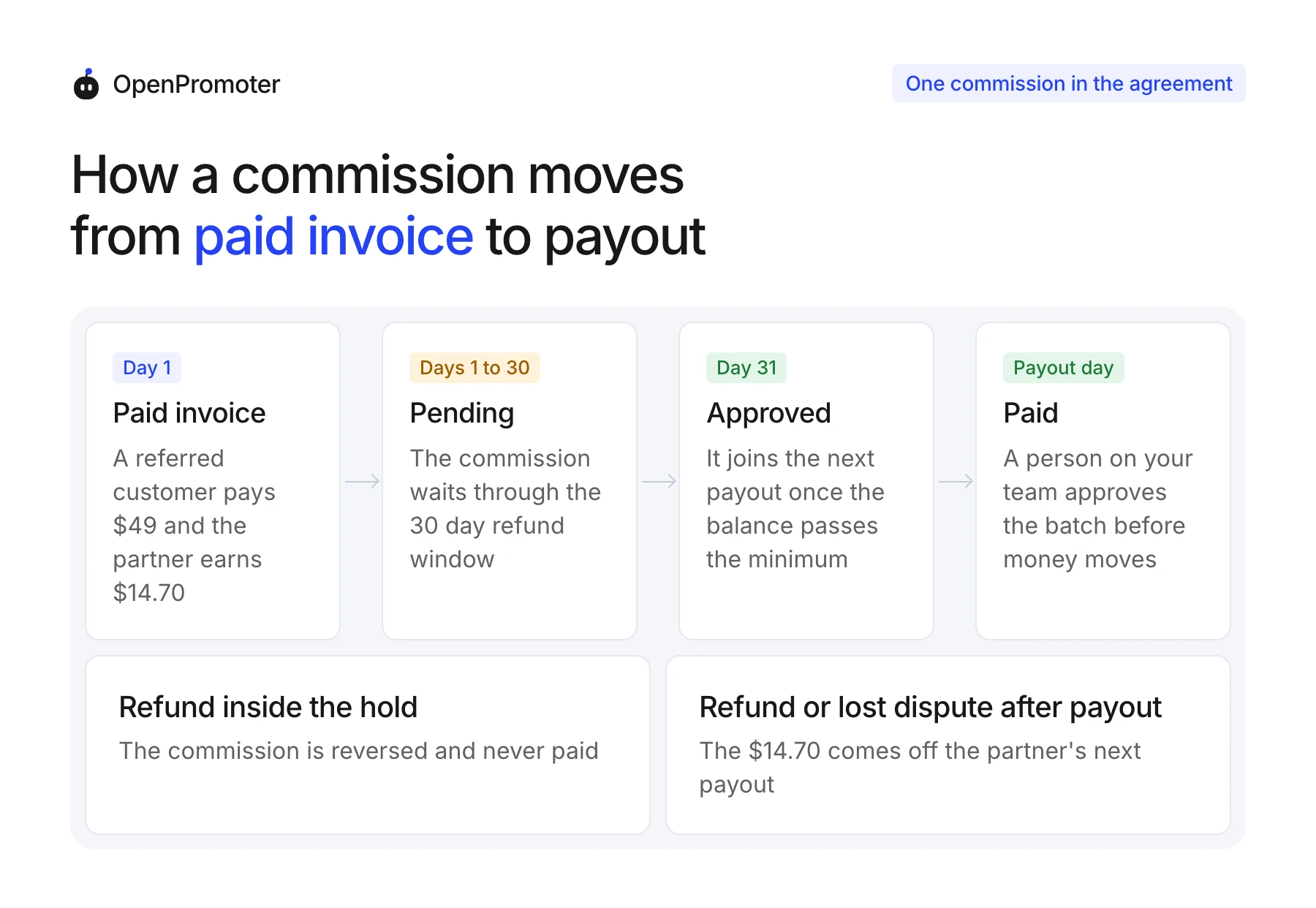
With a 30 day hold, the first $14.70 becomes payable on day 31. Say it goes out with the payout on day 40, and the customer gets a refund for that month on day 45.
The clawback clause then takes $14.70 off the partner's next payout. Without that clause, you have paid a commission on money you no longer have and no written right to get it back.
Payout methods, schedules and fees get their own guide on how to pay affiliates. If you are still choosing the 30% itself, compare real programs in the guide to affiliate commission rates.
Promotion Rules: Self-Referral, Coupon Sites and Brand Bidding
Promotion rules list the ways of promoting your product that never earn a commission. A SaaS agreement should ban self-referral and fake accounts, set a coupon site rule and ban bidding on your brand. Spam and misleading claims about your product belong in the same clause.
Write these four rules into the promotion clause:
- Self-referral and fake accounts: Partners cannot earn on their own accounts or on accounts they control. That includes a second email address, a family member's card and a teammate's account.
- Coupon and deal sites: Say whether partner codes may appear on coupon sites. If they may not, say that you can retire a leaked code and reverse the sales it brought.
- Paid search on your brand: Partners may not bid on your brand name, its misspellings or your domain in paid search ads. Commissions from those clicks are reversed.
- Spam and false claims: No unsolicited email, no fake reviews and no promises about features or prices you do not offer.
Do not count on the ad platform to enforce the brand rule for you. Google's trademark policy for ads lists using trademarks as keywords among the uses it will not restrict.
So the brand bidding rule only exists in your program if your agreement states it. Name the exact terms that count as your brand, because "no brand bidding" alone leaves room to argue about misspellings.
Each of these rules has a matching signal you can check in your data. Our guide on how to prevent affiliate fraud lists the signal and the threshold for each scheme.
The FTC Disclosure Clause for Affiliate Partners
The FTC disclosure clause requires partners to tell their audience that they earn a commission from you. The FTC's Endorsement Guides count that payment as a material connection to disclose when readers would not expect it. The clause should also let you check partner content and act on a missing disclosure.
The rule sits in section 255.5 of the Guides. It says material connections can include monetary payment, and a commission on each sale is exactly that.
The Guides even use an affiliate as an example. A blogger who earns a share of each sale through affiliate links should disclose that compensation in a clear and conspicuous way.
The duty reaches you as the advertiser too. Section 255.1(d) says advertisers should give endorsers guidance, monitor their compliance and act to remedy any non-compliance.
The FTC's Endorsement Guides FAQ adds that advertisers need reasonable programs to train and monitor members of their network. It suggests plain wording such as "I get commissions for purchases made through links in this post."
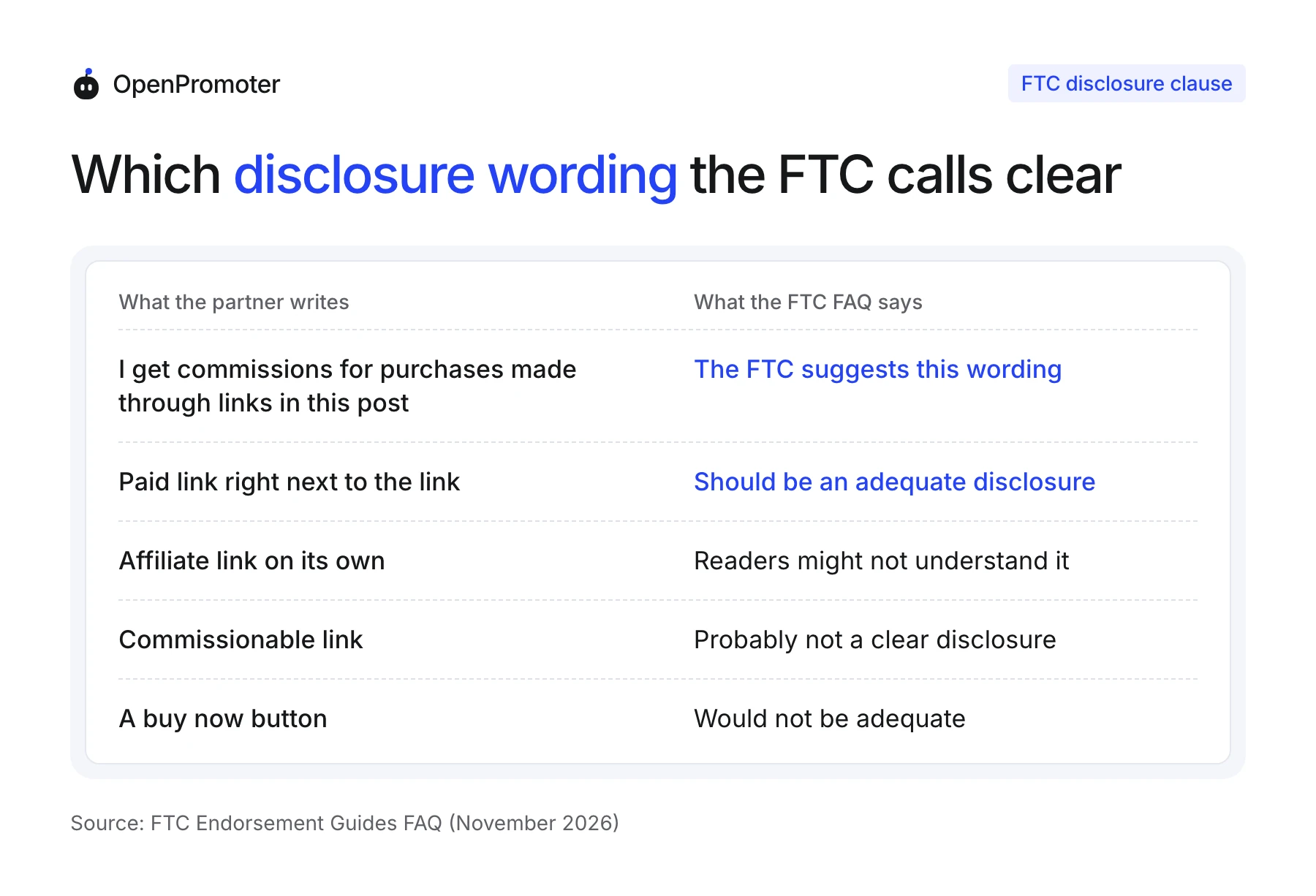
The same FAQ warns that readers might not understand what "affiliate link" means on its own. Ask partners to say in plain words that they are paid when someone buys.
Turn all of this into three duties in the agreement. Partners disclose in plain words close to every link, follow your review requests and fix a missing disclosure within a set number of days.
Changes, Termination and Commissions After It Ends
The changes and termination clauses say how you can change the program and what partners keep when it ends. Give written notice before any change, and apply new rates only to payments made after the change. Then state which commissions are still paid after a partner leaves or is removed.
OpenPromoter's default terms give 30 days' notice before changes. They also promise that commissions already earned and approved are always paid, which partners like to see in writing.
Split termination into two cases. Without cause, either side can end the agreement with notice, and approved commissions go out on the normal schedule.
For a breach of the promotion or disclosure rules, the template lets you end the agreement at once. Unpaid commissions tied to the breach are canceled, and everything else stays owed.
Recurring commissions need one more decision. Some programs keep paying on customers a partner already brought until the duration runs out, and others stop at termination.
Pick one and write it into clause 16. A partner who leaves after bringing 40 customers will ask the question on their last day.
Free Affiliate Agreement Template for SaaS Programs
This free affiliate agreement template has 18 clauses for a SaaS program that pays recurring commissions. Replace each part in square brackets with your own numbers, names and links before you publish it. It is general information and is not legal advice, and a lawyer should review your final version.
The same text works as an affiliate contract template that both sides sign. It also works as an affiliate terms and conditions template that partners accept when they apply.
Copy the whole block below:
[Company] Affiliate Program Agreement
Last updated: [date]

This agreement is between [Company legal name] ("we" or "us") and you, the partner.
You accept it when you tick the box on our application form or sign below.
It applies to the [Product] affiliate program described at [program page URL].

1. Joining the program
1.1 Anyone may apply at [apply URL]. We may approve or refuse any application.
1.2 You must give accurate details and keep them up to date.

2. Relationship
2.1 You are an independent contractor. This agreement does not make you our employee or agent.
2.2 The program is non-exclusive. You may promote other products and we may work with other partners.

3. Commissions
3.1 You earn [30]% of each payment a referred customer makes for [Product], after discounts and before taxes.
3.2 You earn on each payment for [12 months from the customer's first payment / the life of the customer / the first payment only].
3.3 A referred customer is a new customer who pays after clicking your link or using your coupon code under clause 4.
3.4 Free trials, signups and unpaid invoices earn nothing [unless the program page offers a lead reward].
3.5 Rate changes apply only to payments made after the change takes effect.

4. Attribution
4.1 A click on your link counts for [60] days.
4.2 If a customer clicked more than one partner's link, the [last / first] click gets the credit.
4.3 A sale that uses your coupon code is credited to you with or without a click.
4.4 Our tracking records decide which partner gets credit. Tell us about a missed sale within [30] days of the payment.

5. Hold period
5.1 Each commission stays pending for [30] days after the payment to cover our [30] day refund window.
5.2 After the hold, the commission is approved and joins the next payout.

6. Refunds, chargebacks and clawbacks
6.1 A full refund before payout cancels the commission. A partial refund reduces it by the same share.
6.2 If a customer opens a chargeback, the commission is held until it closes. If we lose it, the commission is canceled.
6.3 If a refund or lost chargeback comes after we paid you, we deduct that commission from your next payout.

7. Payouts
7.1 We prepare payouts [monthly on the 1st] for approved commissions.
7.2 The minimum payout is [$50]. Smaller balances roll over to the next payout.
7.3 We pay by [Stripe Connect, PayPal, Wise or bank transfer]. You pay any fees your own provider charges.
7.4 Payouts are made in [USD].

8. Taxes
8.1 Before your first payout you must give us a valid tax form: a W-9 if you are a US person or a W-8BEN or W-8BEN-E if you are not.
8.2 You are responsible for your own taxes on commissions.
8.3 [Optional] You agree that we issue commission invoices on your behalf under a self-billing agreement.

9. Prohibited promotion
9.1 You may not earn commission on your own account, on accounts you control or on accounts created only to earn a commission.
9.2 You may not send spam, post fake reviews, make misleading claims about [Product] or its prices or set tracking cookies without a real click.
9.3 You may not offer customers cash or rewards for using your link unless we agree in writing.

10. Coupon codes
10.1 Your coupon code is for your own audience. You may not post it on coupon or deal sites [unless we agree in writing].
10.2 We may replace a code that appears on such sites and reverse commissions from it.

11. Paid search and brand bidding
11.1 You may not bid on [Brand], its misspellings or [domain] as keywords in any paid search ads.
11.2 You may not use our brand in ad text or display URLs or send paid ads straight to our site through your link.
11.3 We reverse commissions from clicks on such ads.

12. Disclosure
12.1 You must disclose clearly and close to every link or recommendation that you earn a commission from us.
     Example: "I get commissions for purchases made through links in this post."
12.2 You must follow the FTC Endorsement Guides and the advertising rules where your audience lives.
12.3 We may review your content. You must fix a missing or unclear disclosure within [5] days of our request.

13. Brand use
13.1 You may use our name, logo and materials from [content kit URL] only to promote [Product] in this program.
13.2 You may not suggest that you are us or that you speak for us.
13.3 All rights in our brand stay with us.

14. Fraud review
14.1 We may hold any commission while we review it.
14.2 We may reverse commissions that break this agreement and deduct reversed amounts that were already paid.

15. Changes
15.1 We may change this agreement or the program with [30] days' notice by email.
15.2 If you keep promoting after the notice period, you accept the change. If you do not accept it, you may end this agreement under clause 16.

16. Termination
16.1 Either side may end this agreement at any time with [30] days' notice by email.
16.2 We may end it at once if you break clause 9, 10, 11 or 12.
16.3 After termination your links stop earning. Approved commissions are paid on the normal schedule.
16.4 Recurring commissions on customers you referred before termination [continue until the period in clause 3.2 ends / stop on the termination date].
16.5 If we end this agreement for a breach, unpaid commissions linked to the breach are canceled.

17. Liability
17.1 [Indemnity and limitation of liability. Have your lawyer write this clause for your company and country.]

18. General
18.1 This agreement is governed by the laws of [state or country]. Disputes go to the courts of [place].
18.2 This agreement and the program page are the whole agreement about the program.

Accepted by the partner on [date], or signed:
Partner: ____________________   Company: ____________________
How to Fill In, Sign and Store the Agreement
To use the template, match every number in it to your program settings and have a lawyer review the text. Then publish it where applicants read it and make them accept it before they join. Keep each version with its date so you always know what a partner agreed to.
Work through these steps in order:
- Match your settings: Copy the rate, duration, cookie window, hold, minimum and schedule from your affiliate tool into clauses 3 to 7.
- Fill the brackets: Replace every square bracket and delete the options you do not use.
- Get a lawyer's review: Ask for clauses 17 and 18 to be written for your company and the country you operate in.
- Publish the terms: Put them on your program page and link them from the application form.
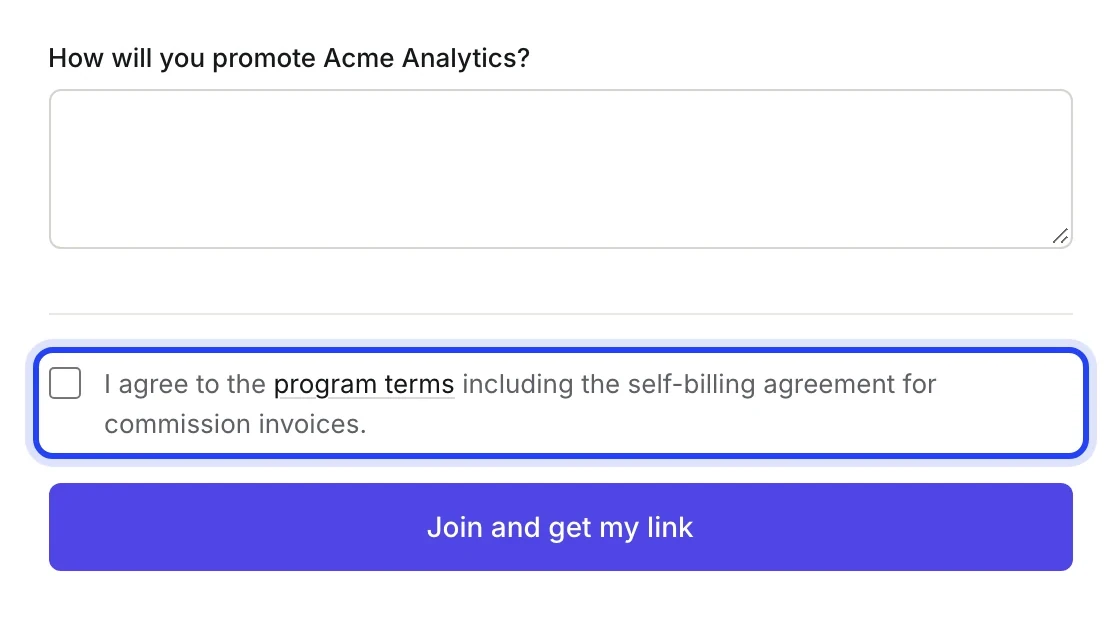
- Require acceptance: Add an unticked checkbox that applicants must tick before they can join.
- Keep every version: Save each version with its date and note which version each partner accepted.
- Announce changes: Email partners before a change takes effect and give them the notice period from clause 15.
OpenPromoter's application form follows step 5. The checkbox is required, and it links to the program terms and the self-billing agreement for commission invoices.
A signed PDF still makes sense for a large creator deal with custom rates. Keep that contract next to the standard terms and note where the two differ.
Mistakes That Make Affiliate Terms Hard to Enforce
The mistakes that weaken affiliate terms are gaps between the text and how the program really runs. A hold shorter than your refund window, a missing clawback line and a vague brand rule all start disputes. Silent changes and a copied governing law clause complete the list.
Check your draft for each of these before you publish it:
- Text that disagrees with settings: The terms promise a 90 day cookie window while the tool counts 60. Partners will quote the written number in every dispute.
- A hold shorter than refunds: A 14 day hold with a 30 day refund promise pays out commissions on sales that can still disappear.
- No clawback wording: Without a written right to deduct, a refund after payout becomes a loss you absorb or an awkward request.
- A vague brand rule: A ban on brand bidding that never names misspellings and your domain invites a partner to test the edges.
- No disclosure checks: The FTC expects monitoring. A disclosure clause with no review step covers only half the duty.
- Silent changes: A rate cut with no notice breaks clause 15 and tells partners the rest of the terms can move too.
- A borrowed governing law clause: A template written for another country can name courts and laws you would never choose.
One habit prevents most of these. Read your terms against your settings page every time you change a number, and update both in the same sitting.
How OpenPromoter Stores and Shows Your Program Terms
OpenPromoter stores your program terms in Settings > Program > Terms and shows them on your public program page. Every applicant must tick a box accepting them before they can join. A new program starts with five default terms covering earning, refunds, banned methods, payouts and changes.
The defaults reverse commissions on refunds and chargebacks and ban self-referrals and brand bidding. They also give 30 days' notice before changes, which matches clause 15 of the template.
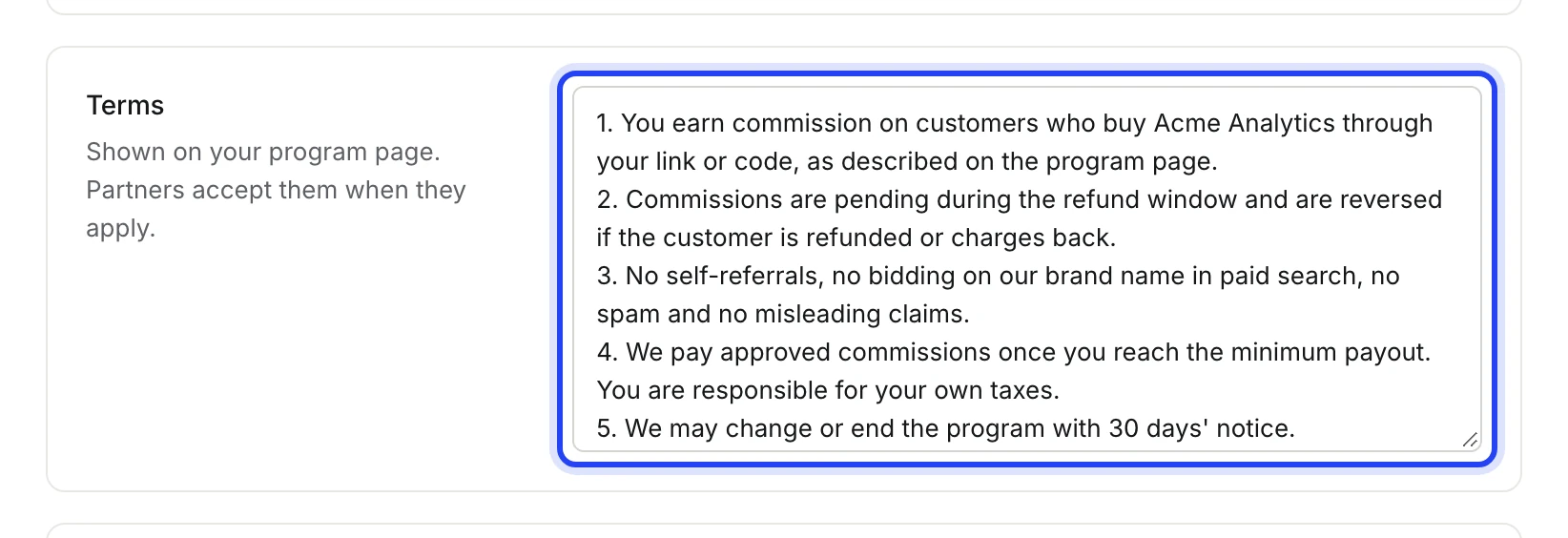
The field holds up to 20,000 characters, and the full template fits with room to spare. Click Save in the bar at the bottom of the page, and the change is written to the audit log.
Partners read the same text in the Program terms section of your program page. The commission, cookie window, refund hold and minimum payout sit on the same settings page. You can match clauses 3 to 7 against them in one place.
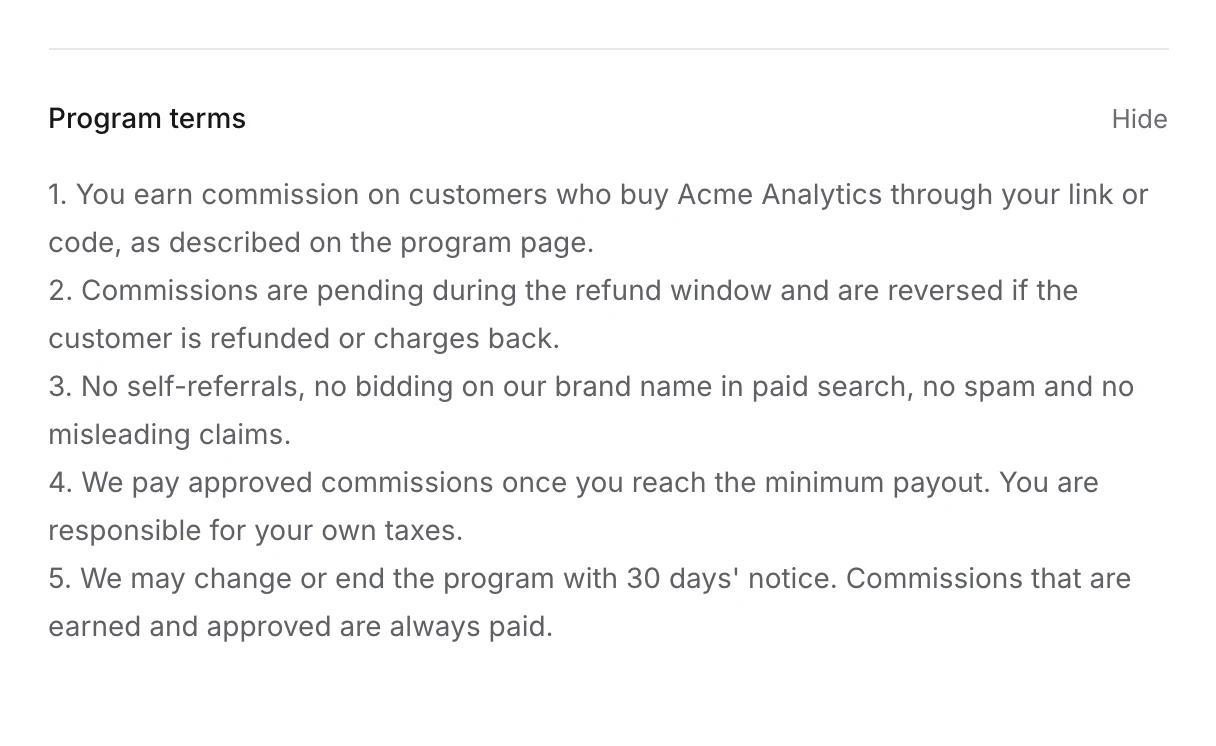
Each payout gets a self-billed commission invoice issued under the agreement partners accept with the terms. The program terms docs show every field, and the commission and refund rules list what happens to a commission after a refund or chargeback.
Conclusion
A good affiliate agreement template for SaaS pays on real revenue for a set number of months. It holds commissions through your refund window and claws back refunds and disputes that arrive after payout.
It also bans self-referral and brand bidding by name and makes FTC disclosure a duty every partner accepts. Google will not stop brand bids for you, and the FTC expects you to monitor your partners.
Copy the template, match every number to your settings and have a lawyer review the liability and governing law clauses. Then publish it where every applicant ticks a box before joining.
Frequently asked questions
Is an affiliate agreement legally binding?
It is written as a contract that both sides accept, either with a signature or a checkbox at signup. Whether each clause holds up depends on the governing law. Ask a lawyer in your country to check yours before you rely on it.
What is the difference between an affiliate agreement and a referral agreement?
An affiliate agreement covers partners who promote you to their own audience for a commission. A referral program rewards existing customers for sending friends, often with credit or discounts. The guide to a SaaS referral program covers that setup.
Do I need a lawyer to write an affiliate agreement?
You can write the business rules yourself, since you know your rates, refund window and brand best. Have a lawyer review the finished text, especially the liability and governing law clauses. Those two depend most on where your company is based.
Can I use a free affiliate agreement template as it is?
Not without editing it. Every bracket holds a business choice only you can make, and a clause that disagrees with your settings starts disputes. Fill it in, match it to your tool and have it reviewed.
What are affiliate program terms and conditions?
They are the same rules as an affiliate agreement, published on your program page for partners to accept. Self-serve SaaS programs use them because every partner accepts the same text when they apply. A large partner may still ask for a signed contract with custom terms.
How long should an affiliate agreement last?
The template runs with no end date until either side ends it with 30 days' notice. A breach of the promotion or disclosure rules lets you end it at once. Recurring commissions after termination are a separate choice, and clause 16 is where you write it down.
Can I change my affiliate terms after partners join?
Yes, if your agreement allows changes with notice. Email partners before the change takes effect and apply new rates only to payments made after it. Let commissions already booked keep their amount.