
Affiliate commission rates for SaaS sit at a median of 30% across the 20 programs we checked. Most of them pay that share on every payment for the first 12 months. The spread runs from 15% to 60%, and your own price and margin decide where you belong in it.
We read each company's own affiliate page in November 2026 and kept only the programs whose page states a rate. One thing to know first: we make OpenPromoter. So the data and the method come first, and our own tool gets one section near the end.
You get the full table with a link to every program, plus the median and the spread. Then comes a five step method that turns your price, margin and churn into a rate. After that we cover recurring and lifetime costs, tiers and bonuses, the cookie window and the mistakes to skip.
What Is an Affiliate Commission Rate?
An affiliate commission rate is the share of a referred customer's payment that you pay the partner who sent them. SaaS programs mostly set it as a percentage of each payment for a fixed number of months. Across the 20 programs we checked, the typical affiliate commission was 30%.
Some programs pay a flat amount per sale instead of a percentage. Semrush is the best known example, and it pays a fixed sum for each new customer.
The rate is only half of the offer. How long it lasts matters just as much, because 30% for 12 months and 30% for life are very different costs.
Physical retail pays far less than software. Amazon Associates lists fixed rates from 0% up to 10% on its standard commission income schedule, with Luxury Beauty at the top.
A customer program works on the same idea with smaller rewards. A SaaS referral program usually pays existing customers in credit or a discount instead of cash.
Affiliate Commission Rates at 20 SaaS Companies
Affiliate commission rates at 20 SaaS companies run from 15% to 60%, with a median of 30% on the entry tier. Eighteen of the 20 pay on every payment, and 13 of those stop after 12 months. Each figure comes from the company's own program page, read in November 2026.
We started with about 40 SaaS affiliate programs of every size, from HubSpot down to one-person tools. A program stayed in only when its own page stated the rate. We dropped pages that gave only an "up to" figure, pages that contradicted themselves and pages that would not load.
That rule removed some well-known names. Webflow and Riverside never loaded a rate for us. The monday.com page gave a top rate with no tier terms, and Instantly listed two ranges on one page.
The table lists the rate a new partner starts on, how long it is paid and the cookie window, sorted by rate:
| Company | Commission | Paid for | Cookie window |
|---|---|---|---|
| Systeme.io | 60% | Life of the customer | Life of the customer |
| Kit | 50% | First 12 months | 90 days |
| beehiiv | 50% rising to 60% by tier | 12 months | 60 days |
| Elementor | 45% | First purchase only | 45 days |
| GetResponse | 40% rising to 60% by tier | 12 months | 90 days |
| HubSpot | 30% | Up to 12 months | 180 days |
| Thinkific | 30% | Life of the customer | 90 days |
| Senja | 30% | Life of the customer | 90 days |
| Podia | 30% | Up to 12 months | 90 days |
| Close | 30% | First year | Not stated |
| SE Ranking | 30% | Not stated | 120 days |
| Unbounce | 25% to 35% | Up to 12 months | 90 days |
| Fathom Analytics | 25% | Life of the customer | 30 days |
| Transistor | 25% | Life of the customer | 30 days |
| lemlist | 25% | 12 months | 30 days |
| Castos | 25% | Up to 12 months | 30 days |
| ActiveCampaign | 20% rising to 30% | Up to 12 months | Not stated |
| Pipedrive | 20% rising to 30% by tier | First 12 months | 90 days |
| Notion | 20% plus up to $50 per signup | Year one | Not stated |
| Apollo | 15% on monthly plans and 20% on annual | First 12 months | Not stated |
Two rows need a note. Thinkific and Notion both say they are not taking new affiliates as of November 2026. Their published rates still show what each company chose to pay.
Kit also adds 10% for as long as the customer stays once a partner refers 10 or more creators in a year. The table shows only the rate every new partner gets.
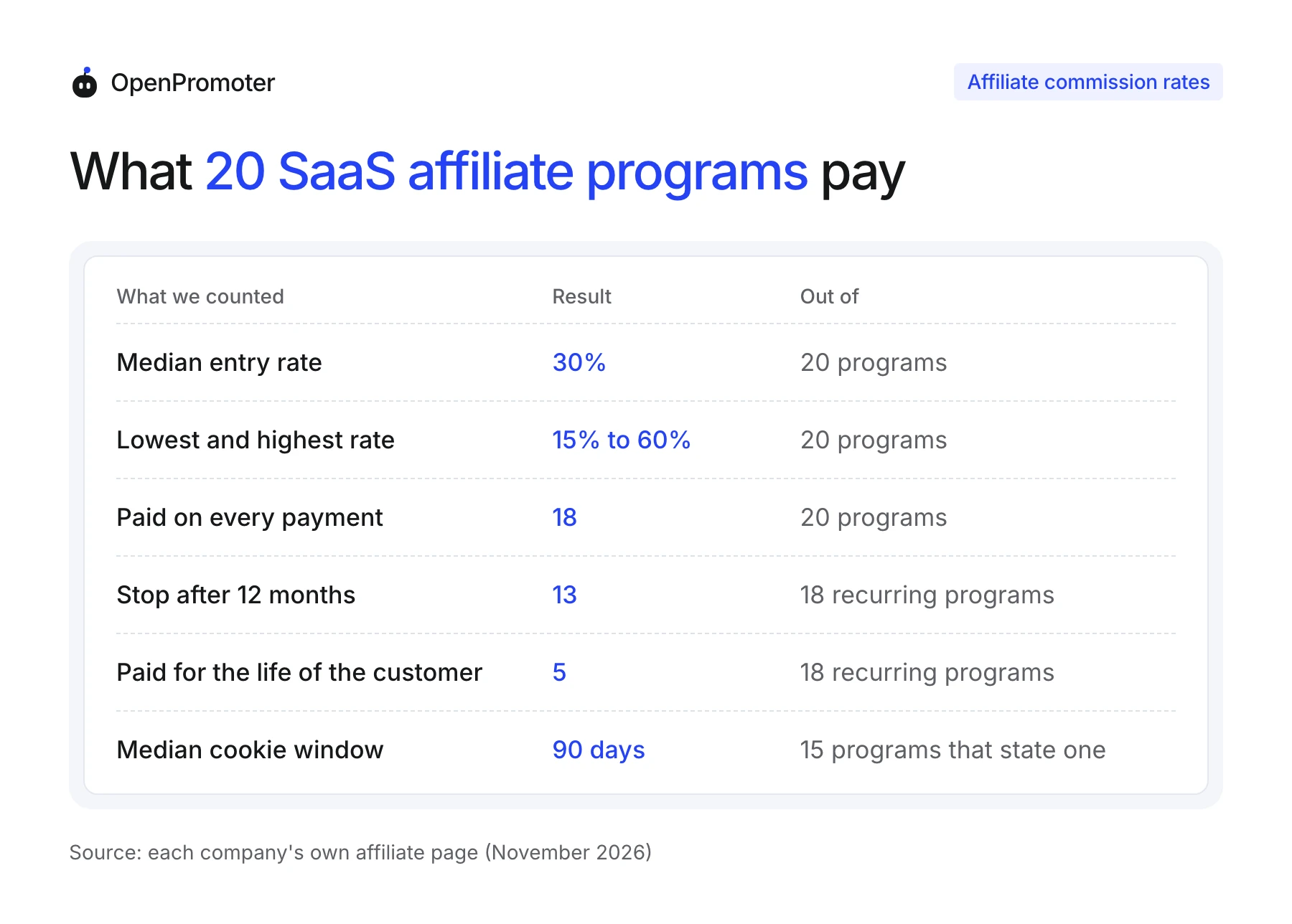
Of the 20 programs we checked, the median entry rate is 30% and the average is about 31%. Six programs sit exactly on 30%, which is more than at any other rate.
Duration is where the programs split. Five of the 18 recurring programs pay for the life of the customer: Systeme.io, Thinkific, Senja, Fathom Analytics and Transistor. The other 13 stop at 12 months or at the end of the first year.
Only Elementor pays once, on the first purchase. SE Ranking states its 30% rate and its 120 day cookie but not how long the commission lasts.
What Is a Good Affiliate Commission for SaaS?
A good affiliate commission for SaaS is one partners notice and you can afford for as long as it runs. Going by the table, 25% to 30% recurring for 12 months is the common ground. Go higher when your price is low or your margin is high.
The average affiliate commission in our table is about 31%, a little above the 30% median. A few programs at 50% and 60% pull the average up.
The high payers have something in common. Systeme.io, Kit and beehiiv all sell tools for creators, and many of their own customers run an audience they could promote to.
The low end tells a different story. Apollo starts at 15% on monthly plans, and Notion, Pipedrive and ActiveCampaign all start at 20%.
A lower rate can still pay more in dollars. As an example, 20% of a $100 plan is $20 a month, while 50% of a $9 plan is $4.50.
Some programs skip the percentage of every payment. Surfer pays 75% to 125% of a referral's first monthly payment, rising with how many customers a partner has sent.
Kajabi pays a bounty of 100% of the first month on a partner's first four referrals. From the fifth it pays 10% recurring, rising to 20% at 50 active referrals.
Three more programs pay a flat amount per customer. Semrush pays $100 to $300 per sale plus $10 per free trial. Descript pays $25 per new subscriber, and Shopify pays up to $150 per qualified referral.
Partners compare what they earn per customer and how long they keep earning it. Your rate becomes part of the pitch when you start finding affiliates for SaaS. Set it before the first message goes out.
How Much Commission to Pay Affiliates
To decide how much commission to pay affiliates, work out what one customer is worth and what you will spend to win one. Then divide that budget by the revenue the commission is paid on. The result is your ceiling, and your rate sits at or below it.
Work through these five steps with your billing data open:
- Find gross profit per month: Multiply your plan price by your gross margin. Gross margin is what stays after hosting, support and payment fees.
- Estimate how long a customer stays: Divide 1 by your monthly churn rate. At 4% churn a month, an average customer stays about 25 months.
- Work out what a customer is worth: Multiply gross profit per month by those months. This is a simple customer lifetime value.
- Pick your budget to win one customer: Decide what share of that value you will spend. Compare it with what ads or a sales call cost you today.
- Divide by the revenue you pay on: Divide the budget by the payments inside your commission window. The answer is the highest affiliate commission you can afford.
Here is a worked example with round numbers. Say your plan costs $50 a month, gross margin is 80% and monthly churn is 4%. Each customer brings $40 a month in gross profit and stays about 25 months.
That makes one customer worth $1,000 in gross profit. Say you are willing to spend a third of it to win one, which is $333.
Over 12 months the customer pays at most $600. So $333 divided by $600 caps a 12 month rate at about 55%.
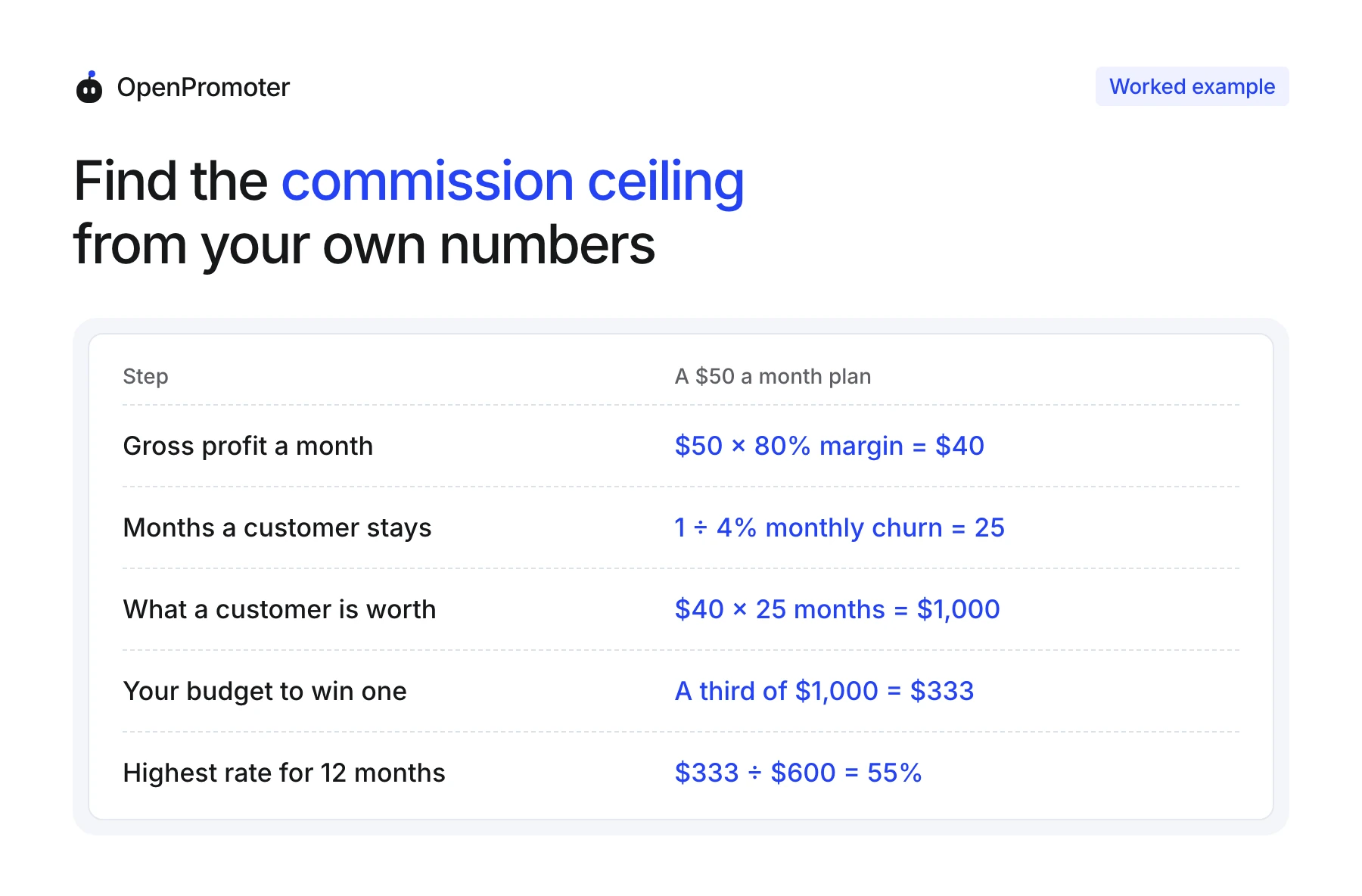
You would not pay the ceiling. A 30% rate for 12 months costs at most $180 per customer, and less when the customer leaves early. That leaves room for payout fees, a customer discount and a later bonus.
The shortcut of 1 divided by churn is rough for a young product. Use your real retention once you have a year of customers to measure.
Tip: Run the same math on your cheapest plan. A rate that works on a $50 plan can pay a partner only a few dollars a month on a $9 one.
The guide to starting a SaaS affiliate program shows the starting rates the OpenPromoter setup wizard proposes for each price band.
Recurring vs One-Time vs Lifetime Commissions
A recurring commission pays on every invoice for a set time, and a lifetime commission pays while the customer stays. A one-time commission pays once. Most recurring commission affiliate programs in our table stop at 12 months, which pays partners well and protects your long-term margin.
The same $50 plan shows how far apart the three shapes sit. Each card uses the numbers from the worked example above.
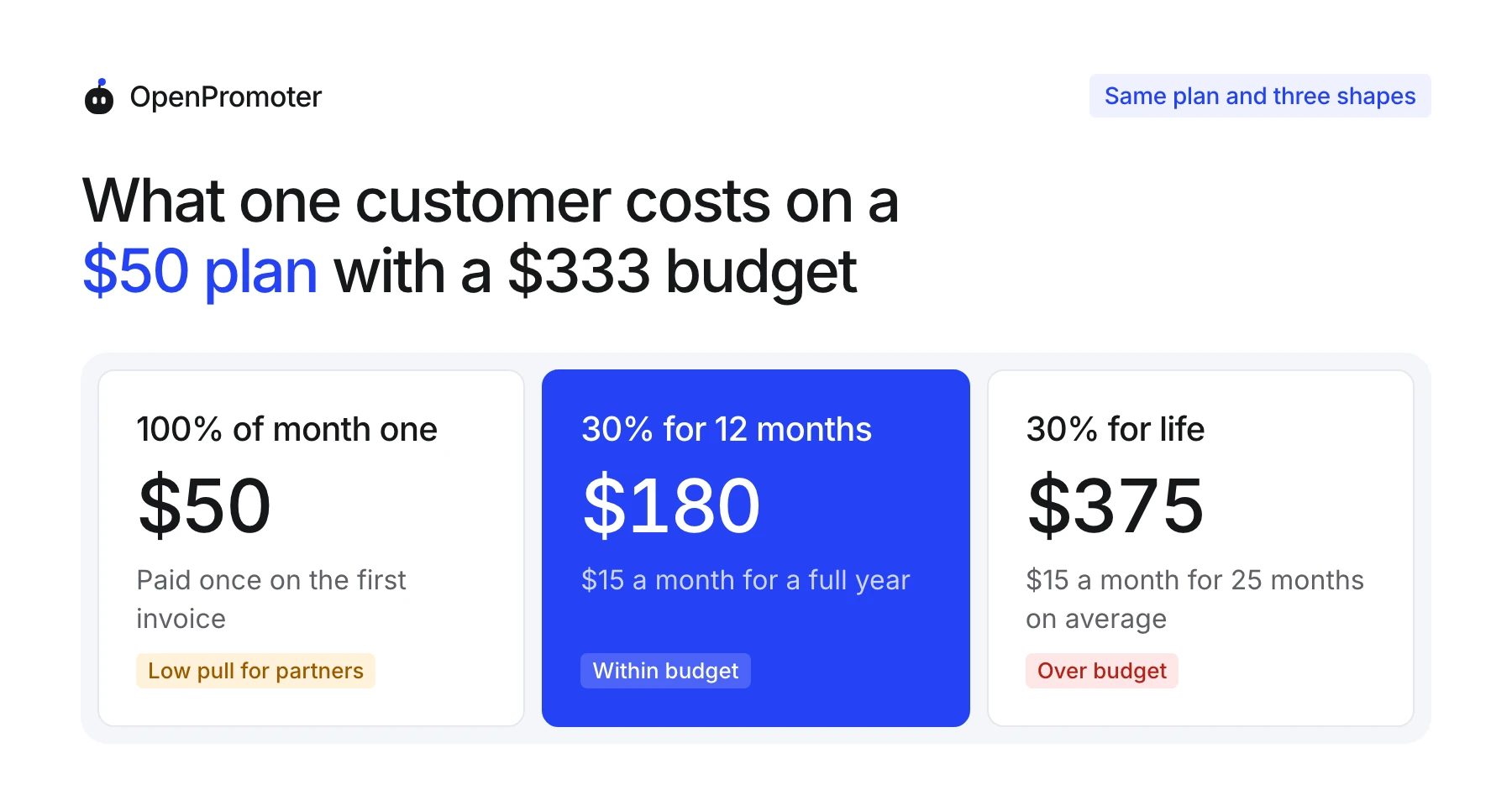
A one-time payment of the first month costs $50 and is easy to budget. That is a small reward for a customer you keep for about 25 months.
Thirty percent for 12 months costs at most $180. It gives the partner a full year of income from one customer and stays well inside the $333 budget.
Thirty percent for life costs $375 for an average customer who stays 25 months. That is over budget, and the cost keeps growing for every customer who stays longer.
Customers can stay far longer than a year. Kit says its average customer stays 40 months. A 12 month cap covers less than a third of that.
A middle path pays a lower rate after the first year. Kit does this for its busiest partners, adding 10% for as long as the customer stays.
One-time commissions still fit some cases. They suit one-off purchases and annual plans paid up front, and Elementor pays 45% on a first purchase only.
Tiers, Bonuses, Lead Rewards and Two-Tier Commissions
Tiers, bonuses, lead rewards and two-tier overrides let you pay more for the results you want without raising everyone's base rate. Tiers reward volume, bonuses reward a push and lead rewards pay before a sale. A two-tier override pays partners for the partners they recruit.
Real programs use each of these. Here is what each one looks like:
- Volume tiers: GetResponse starts every partner at 40% and moves them to 50% after 50 sales in 12 months. A partner with 100 sales in that time earns 60%.
- Steady-seller tiers: Pipedrive raises its 20% to 30% for partners with two to five sales a month for six months in a row.
- Content bonuses: Semrush adds a quarterly content bonus of $200 to $1,500, depending on the partner's tier.
- Lead rewards: Notion pays up to $50 per activated signup on top of its revenue share. Semrush pays $10 for each free trial.
- Short boosts: A higher rate for two weeks gives partners a reason to post now. It works well around a launch, a price change or a Black Friday partner campaign.
- Two-tier overrides: A recruiter earns a share of what their recruits earn. A 10% override on a $30 commission adds $3 on top.
Base every tier and bonus on paying customers or revenue. A tier that counts clicks or signups pays people to fake them, which our guide to preventing affiliate fraud covers in detail.
Lead rewards need the most care of the four. A fake signup costs nothing to create. Hold the reward until the account looks real or pays.
Keep tiers few and easy to read. Two or three steps with clear thresholds give partners a target they can see on their dashboard.
How Long Should Your Cookie Window Be?
Set your cookie window longer than your free trial and your usual buying cycle. Of the 15 programs in our table that state one, the median window is 90 days. The range runs from 30 days at lemlist and Castos up to 180 days at HubSpot.
Systeme.io goes further and ties a referral to the partner for life. A longer window costs you little when commissions only book on paid invoices.
Cookies are only one signal. Coupon codes and click ids passed to checkout keep the credit after a cookie expires. The affiliate tracking docs show how each signal credits a partner.
Mistakes When Setting Affiliate Commission Rates
Most commission mistakes come from copying another program's rate without running your own numbers. The rest come from changing terms without warning or paying before refunds settle. Each one below is cheap to avoid at launch and expensive to fix once partners depend on the old terms.
Check your offer against these before the first partner joins:
- Copying the median: A 30% rate fits a $50 plan with 80% margin. It may not fit yours. Run the five steps first.
- Lifetime on a thin margin: A lifetime share keeps costing as customers stay. Cap it at 12 months or pay a lower rate after the first year.
- A rate too small to notice: 20% of a $9 plan is $1.80 a month. Few partners will write a review for that.
- Tiers built on clicks: Clicks are cheap to fake. Count paying customers or revenue instead.
- Cutting rates without notice: Partners build content around your rate. Write how and when you can change it into your affiliate agreement template.
- Paying before refunds settle: Hold each commission through your refund window. Schedules, minimums and holds are covered in how to pay affiliates.
lemlist shows a clawback in practice. Its program may take back the reward when a customer downgrades to free or gets a refund in the first two months.
How to Set Commission Rates in OpenPromoter
In OpenPromoter you set the program rate, how long it lasts and any lower rate for life on one Commission card. Tiers, product rates and a custom rate for one partner can replace that rate. A campaign boost then multiplies the result while it runs.
Open Settings > Program and find the Commission card. Pick a percent of each payment or a fixed amount. Then set the rate and the duration.
The duration options are first payment only, recurring for a number of months or the lifetime of the customer.
The default is 30% recurring for 12 months, which matches the median in our table. The Then, for life field adds a lower rate after those months. For example, 30% for 12 months and then 10% on a $49 plan pays $14.70 a month for a year and $4.90 after that.
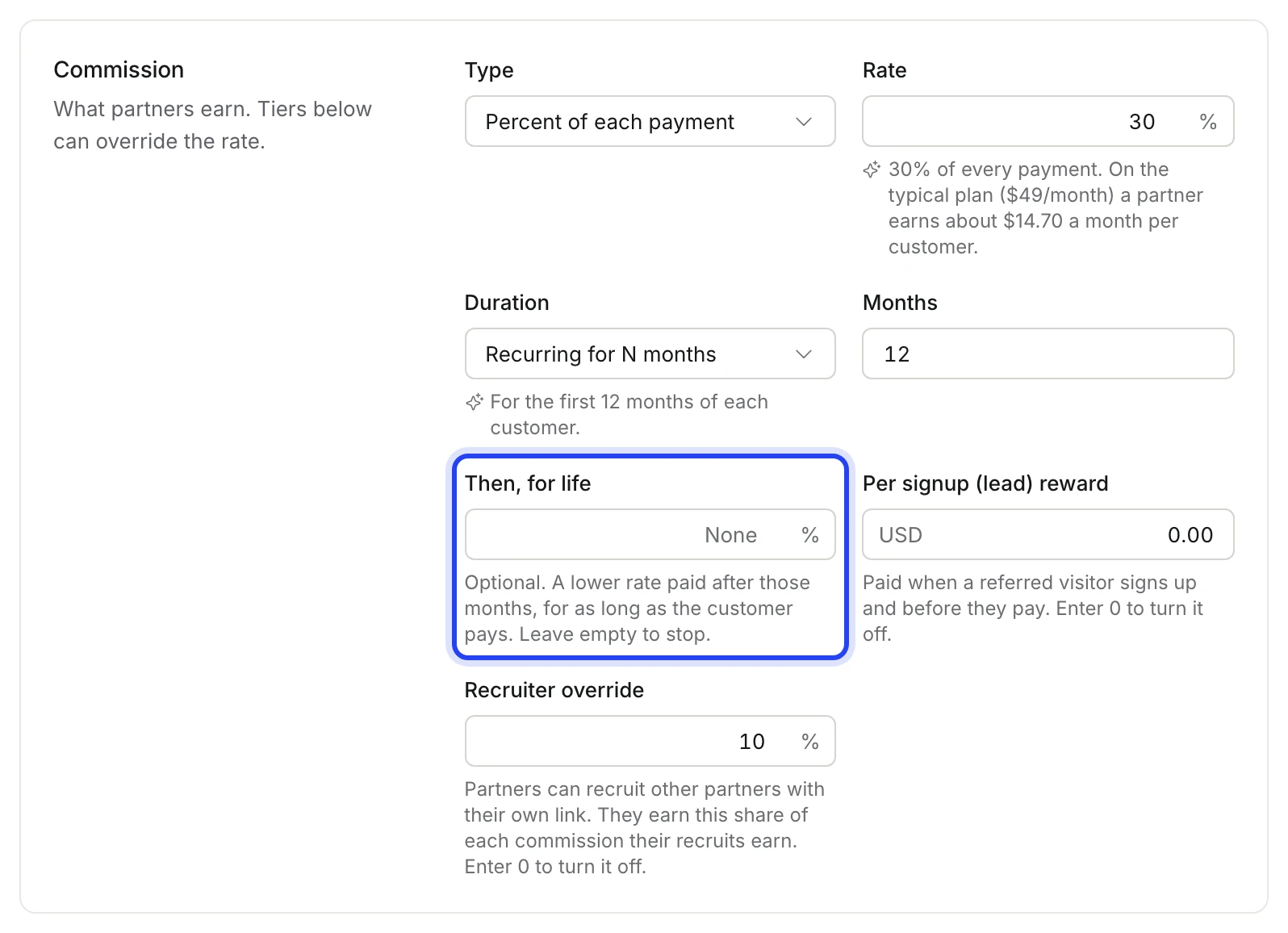
The same card holds a per signup lead reward and a recruiter override for two-tier commissions. A signup reported only by the browser script stays held until you approve it.
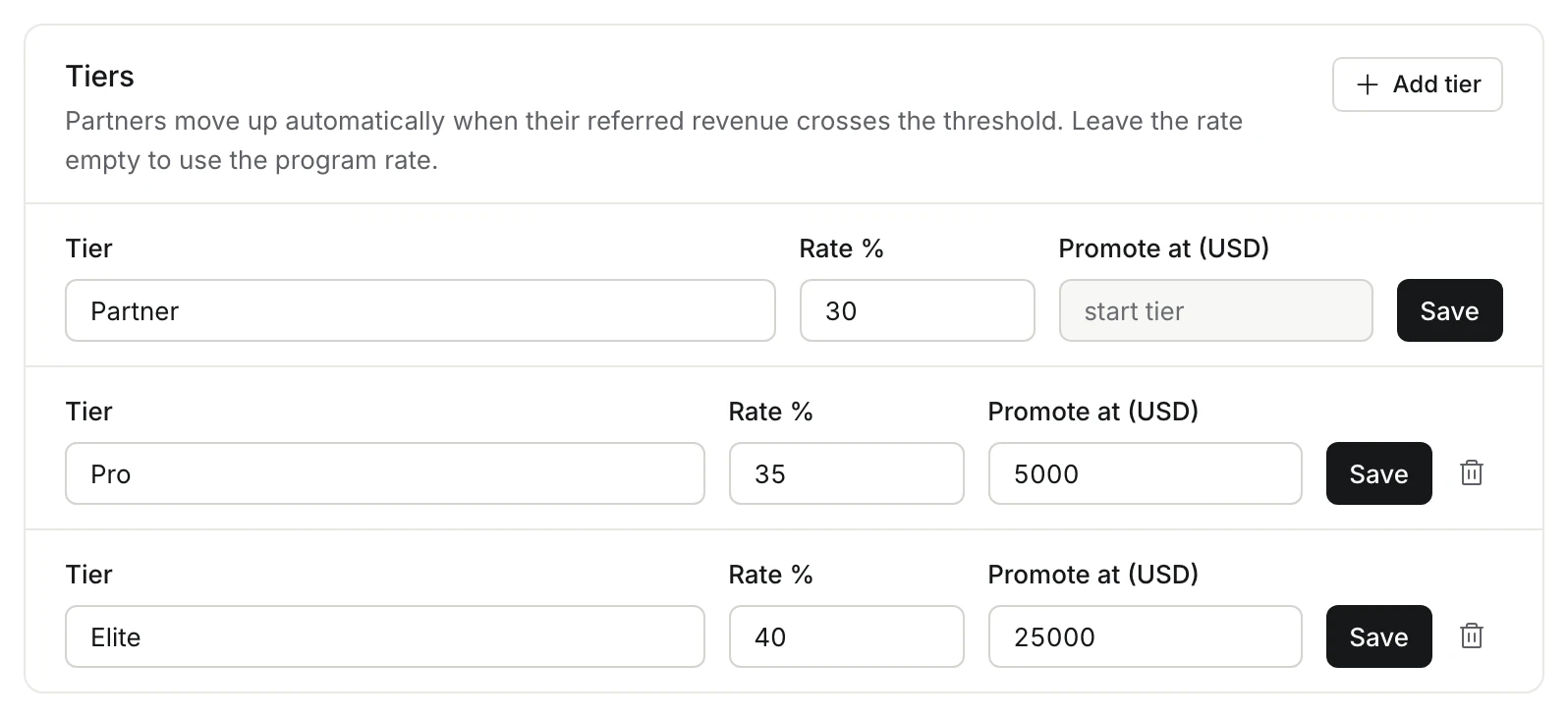
Tiers move partners up on their own once their referred revenue crosses a threshold. They never move a partner down.
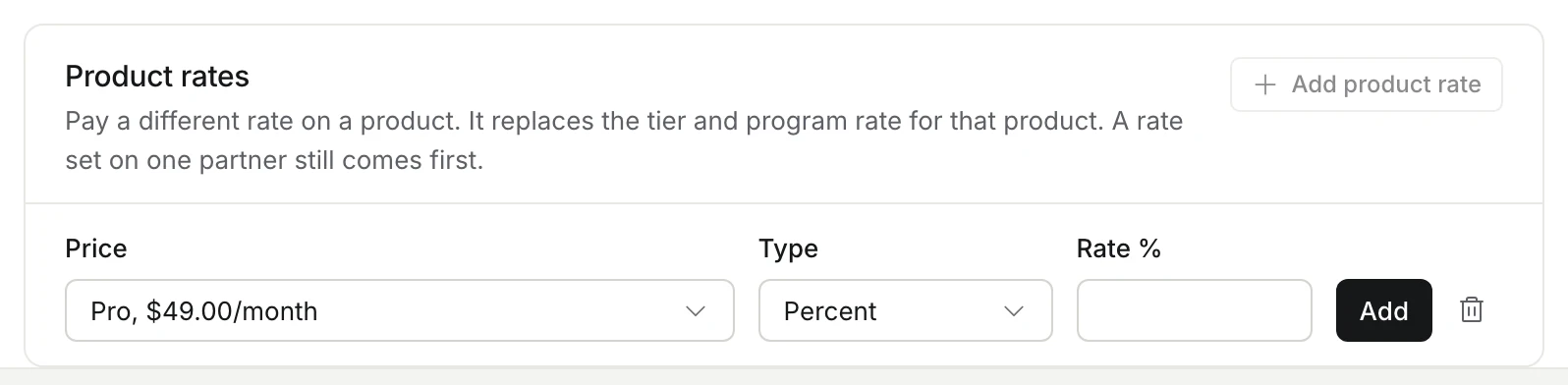
Product rates pay a different rate on one price, such as a lower share on an add-on. They work with Stripe, Paddle, Lemon Squeezy, Polar and Chargebee.
When more than one rate could apply, the first match wins in this order:
- A custom rate on the partner's page
- A product rate for the price or product
- The partner's tier rate
- The program rate
A live campaign boost multiplies the result by up to 5x, and only the strongest boost applies. Changing a rate affects new payments only. The commissions docs list every field and what happens on a refund.
Conclusion
Affiliate commission rates for SaaS cluster around 30%, paid on every payment for the first 12 months. Of the 20 programs we checked, the spread ran from 15% to 60%, and 5 of the 18 recurring programs pay for life.
Use the median as a reference point and your own numbers as the decision. Work out what a customer is worth and pick the share you will spend to win one. Divide that budget by the revenue in your commission window.
Then add tiers or a lower rate for life once partners prove they can sell. A rate you can keep paying for years is worth more to partners than a high one you cut later.
Frequently asked questions
What is the minimum commission rate affiliates will accept?
No survey we could verify sets a minimum. Among the 20 programs we checked, the lowest entry rate was 15% on Apollo's monthly plans. Sixteen of the 20 started partners at 25% or more.
Is a 50% affiliate commission too high?
It depends on how long it runs and on your margin. Kit and beehiiv pay 50% but stop after 12 months. Run the five step method before you match them, because 50% for life can cost more than a customer brings in.
Should annual plans pay a different commission?
Some programs pay a higher rate on annual plans. Apollo pays 20% on annual plans against 15% on monthly ones. An annual plan pays the whole year up front, and the partner gets a year of commission at once.
Do affiliates earn commission on renewals and upgrades?
On a recurring plan they do, as long as the payment falls inside the commission window. An upgrade raises the commission because it is a share of what the customer paid. Payments after the window earn nothing unless you pay a lower rate for life.
Can you change your commission rate after launch?
You can, but tell partners first and apply the new rate only to new payments. Commissions already earned should keep their amount. Raising a rate is easy, while cutting one costs trust with the partners who built content around it.
Should you pay commission on refunded sales?
No. Hold each commission through your refund window and cancel it if the customer refunds. If a refund lands after payout, take the amount off the partner's next payout and say so in your terms.
Why do SaaS programs pay more than Amazon Associates?
Amazon's commission schedule tops out at 10%, with many categories far lower. A subscription pays again every month. That lets a SaaS program share a slice of each payment for a year or more.