
Open source affiliate software is affiliate and referral program software with public code. You can read it, run it on your own server and change it. It tracks which partner sent each customer, books a commission on every sale and prepares payouts.
This guide uses each project's repository and the vendor pricing pages, all read in November 2026. One thing to know first: we make OpenPromoter. It gets its own sections near the end.
You get a plain definition and a price table. After that come the four open source projects, six checks to run before you pick one and a Docker setup that takes about five minutes.
What Is Open Source Affiliate Software?
Open source affiliate software is a partner program tool published under an open license. You can download the code, host it yourself and see exactly how clicks, commissions and payouts are calculated. Some projects also sell a hosted version for teams that prefer not to run a server.
Most SaaS founders choose it for three reasons. Price comes first, since a self-hosted copy has no monthly fee. Control of partner data and a commission engine you can read follow.
Why Founders Pick Open Source Affiliate Software
Hosted affiliate tools charge a monthly plan, and some also take a share of every payout you send to partners. Open source software can drop both. A self-hosted copy has no plan fee, and a project that takes 0% of payouts keeps your partner costs flat as the program grows.
The table shows list prices for the hosted tools most founders compare first. Prices come from each vendor's pricing page as of November 2026.
| Entry price | Fee on payouts | Open source | |
|---|---|---|---|
| OpenPromoter | $0 (self-host or Cloud Free) | 0% | Yes (AGPL-3.0) |
| Rewardful | $49/mo | 0%, or 3% with Managed Payouts | No |
| FirstPromoter | $49/mo | None listed | No |
| Tolt | $99/mo | 2% of payouts | No |
| Dub Partners | $81/mo | 5%, or 8% card-funded | Partner code is closed |
Full comparisons are on our pages for Rewardful, FirstPromoter and Tolt. Our affiliate marketing platform guide covers what each plan costs at different program sizes.
The Open Source Affiliate Software Options in 2026
These four open source projects cover affiliate or referral tracking for SaaS in 2026. They share a self-hosted approach and differ in license, stack and scope. This section lists the facts from each repository so you can compare them against your own needs.
| Project | License | Stack | Hosted version |
|---|---|---|---|
| OpenPromoter | AGPL-3.0 | Next.js and Postgres 16 | Yes (Free to $199 a month) |
| Refferq | MIT | Next.js, Prisma and Postgres | Self-host |
| Numok | MIT | PHP 8.1 and MySQL | Self-host |
| RefRef | AGPL-3.0 | Next.js, Better-Auth, Drizzle and Postgres | Self-host |
A license is the first filter. MIT lets anyone reuse the code in closed products. AGPL-3.0 lets you run and change it freely, and a company that hosts a modified copy for others has to share its changes.
Pick the license that matches how you plan to use the code. If you only run it for your own program, both work.
6 Checks Before You Choose Open Source Affiliate Software
Six checks tell you whether an open source affiliate project can run a real program with real money. They cover billing support, refund handling, fraud flags, payouts, hosting work and the path to switch. Run them on every option you shortlist.
1. Does It Read Your Billing System?
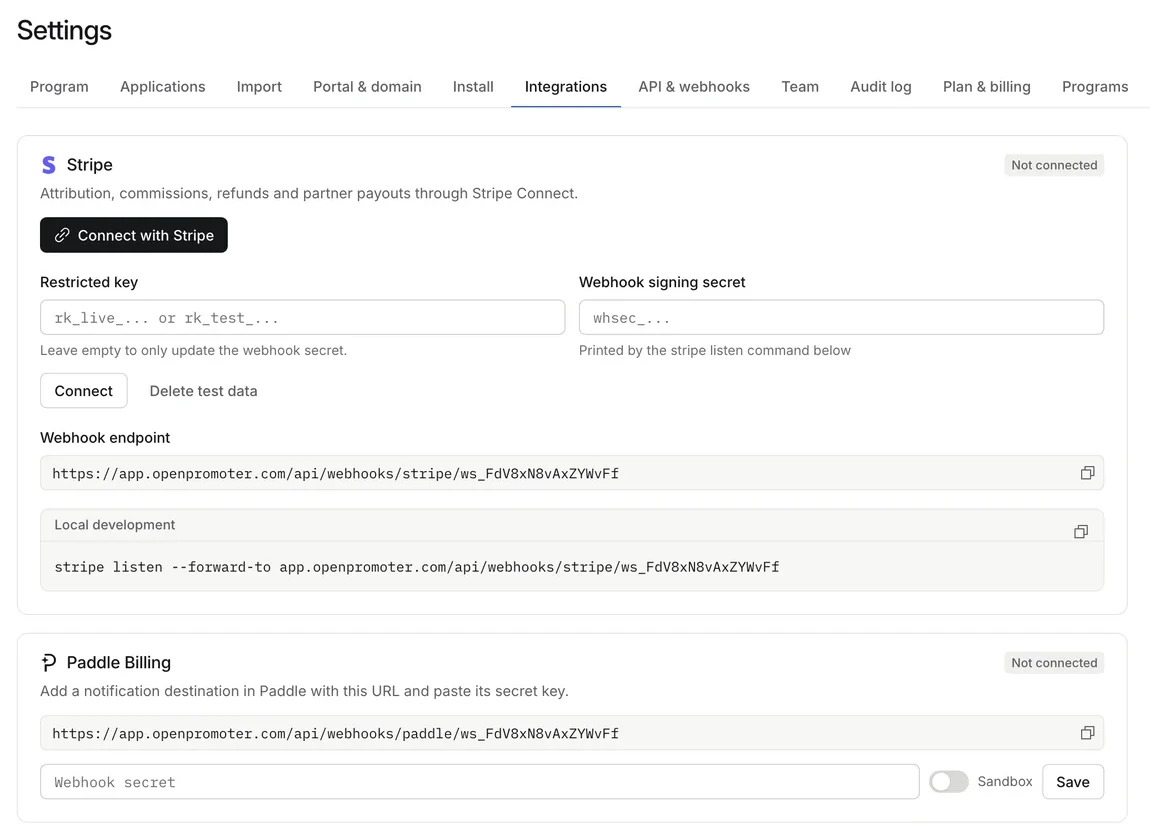
Commissions come from payments. The tool has to read yours. Check the supported list and whether it listens to webhooks or asks you to enter sales by hand.
OpenPromoter reads Stripe, Paddle, Lemon Squeezy, Polar, Chargebee and Dodo Payments, and you can connect several at once. The billing providers docs show each setup. Sales from any other system can come in through the REST API.
2. Does a Refund Change the Commission?
A refund after a commission is booked should reduce it. Look for refund and chargeback events in the docs and a hold period before a commission becomes payable.
OpenPromoter holds commissions for 30 days by default and lets you raise that to 180. A refund lowers or cancels the commission, and a refund after payout comes off the partner's next balance. The commissions docs list the rules.
3. Does It Flag Fraud Before You Pay?
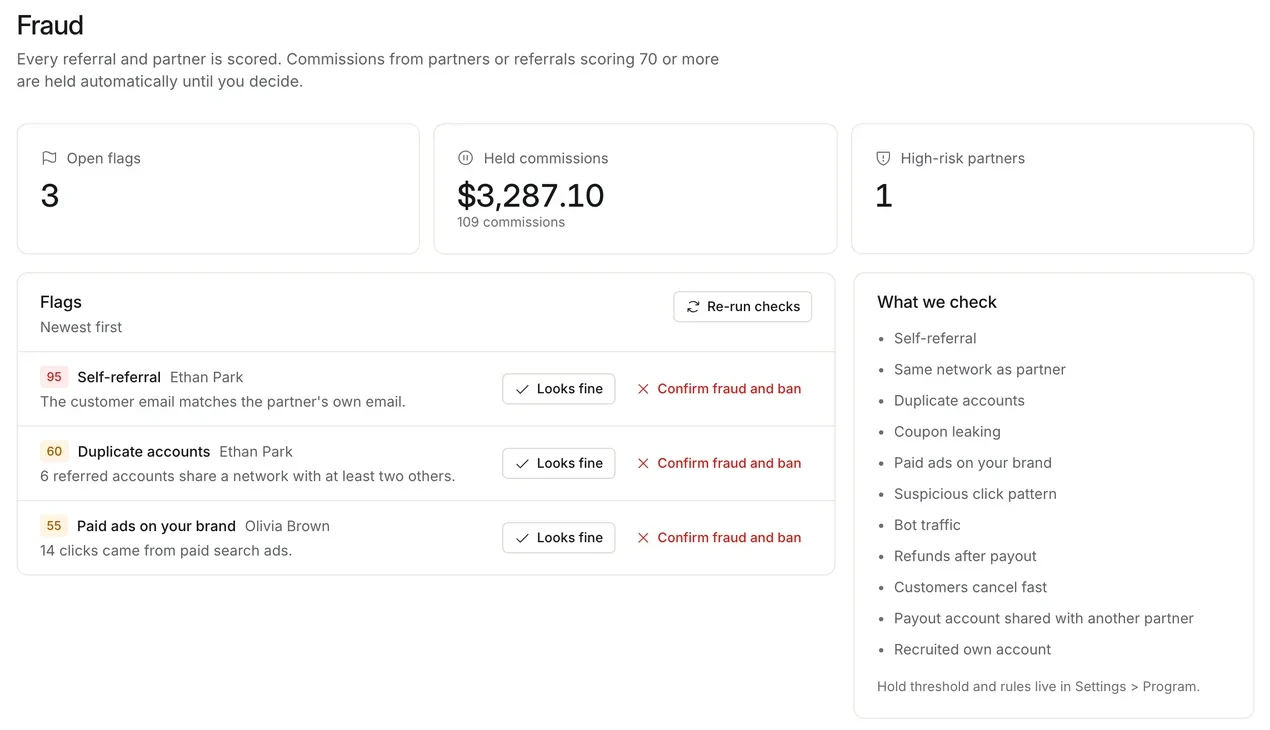
Self-referral, duplicate accounts and paid ads on your brand are the usual problems. A tool that scores each referral lets you hold risky ones for review.
OpenPromoter scores every referral from 0 to 100 against 11 checks. Commissions scoring 70 or more are held until you decide.
4. How Does It Pay Partners?
Some projects stop at tracking and leave payouts to a spreadsheet. Others prepare the batch and send the money for you.
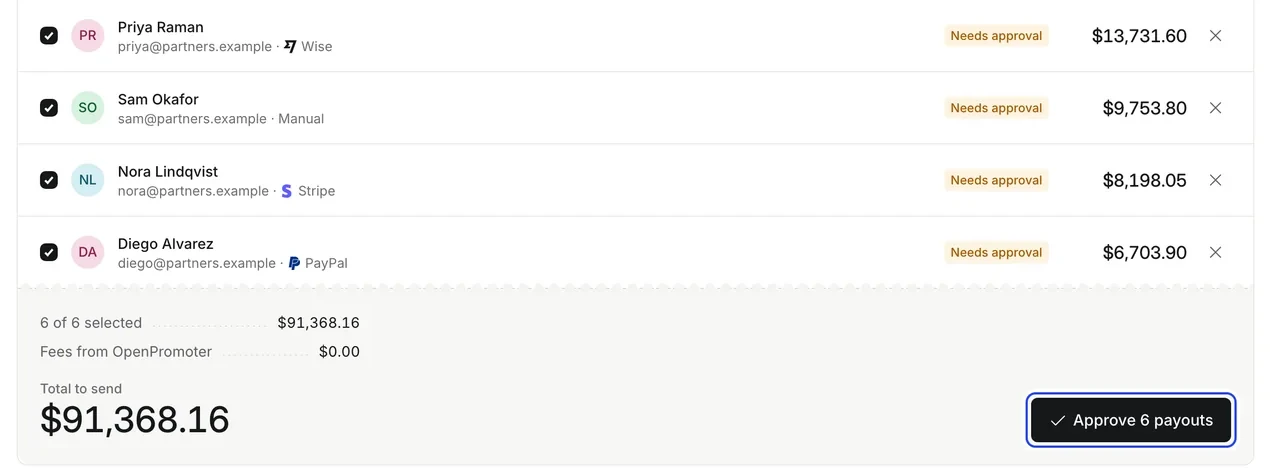
OpenPromoter builds a payout batch for you to approve. It pays through Stripe Connect, PayPal or Wise and adds 0% on top of those providers' own fees. The approval screen shows the total and the fee line before you send anything.
5. How Much Work Is Hosting It?
Look for a prebuilt image, a short list of services and a documented upgrade path. Fewer moving parts mean fewer 3 a.m. problems.
OpenPromoter runs as one container with PostgreSQL 16 and needs no Redis, because its job queue is a Postgres table. The image is published for amd64 and arm64. The next section shows the full setup.
6. How Do You Switch Over?
A project is easier to adopt when your partners keep their links. Check for an importer and for support of the link formats you already use.
OpenPromoter imports partners, their referred customers and unpaid balances from a CSV. Links that use ?via=, ?fpr=, ?ref=, ?gspk= or Lemon Squeezy's ?aff= keep working. Our guide to migrating an affiliate program walks through the cutover.
How to Self-Host Open Source Affiliate Software With Docker
You can self-host OpenPromoter in five minutes with Docker Compose. Clone the repo, run one command and open the dashboard on port 3000. The compose file starts the app, PostgreSQL 16 and a local inbox, and it seeds a demo workspace you can click through.
Run these three commands:
git clone https://github.com/openpromoter/openpromoter
cd openpromoter
docker compose up
Open http://localhost:3000 and sign in as demo@openpromoter.test with the password openpromoter-demo. The demo holds 100,000 clicks, 10,000 conversions and payouts waiting for approval. Emails land in Mailpit at http://localhost:8025.
For a real server, set APP_URL, two long random secrets (BETTER_AUTH_SECRET and ENCRYPTION_KEY) and an email provider. The self-hosting guide covers Railway, Render and upgrades.
Prefer a one click start? The README has Deploy buttons for Render and Railway.
Want to look first? The live demo needs no signup and no card.
Self-Host or Use the Cloud Version?
Self-hosted OpenPromoter has every feature with no revenue or partner limits, and it costs your server bill. The Cloud version is free until your partners bring in $1,000 a month. Paid plans are flat tiers from $29 to $199 with 0% on payouts.
| Plan | Partner revenue a month | Price |
|---|---|---|
| Free | Up to $1,000 | $0 |
| Starter | Up to $10,000 | $29 |
| Growth | Up to $50,000 | $79 |
| Scale | Up to $250,000 | $199 |
Yearly billing gives two months free. The pricing page lists what each plan includes. You can start on Cloud and move to your own server later, or the other way around.
Conclusion
Open source affiliate software gives you control of your data, a readable commission engine and a lower monthly bill. Compare the options on license, billing support, refund handling, fraud checks, payouts and the path to switch.
OpenPromoter covers all six and runs with one docker compose up.
Open the live demo to see the dashboard and partner portal with sample data. Then start on the free Cloud plan or clone the repo and run it yourself.
Frequently asked questions
What is the best open source affiliate software for SaaS?
It depends on your billing system and how you plan to pay partners. OpenPromoter supports six billing providers, holds risky commissions for review and sends payouts after you approve them. Check the six questions above against any project you shortlist.
Is open source affiliate software free?
The code is free to download and run. You pay for the server and email sending. OpenPromoter's Cloud version is also free until your partners bring in $1,000 a month in revenue.
Can I self-host affiliate software?
Yes. OpenPromoter runs with Docker Compose and PostgreSQL 16 on any server that runs containers. The self-hosting guide lists the settings for a production install.
What does the AGPL license mean for my program?
You can run and change OpenPromoter for your own program with no limits. The AGPL-3.0 license asks anyone who hosts a modified copy for other people to share their changes. The SDK, CLI and tracking script are MIT licensed.
Can I move my partners from Rewardful or FirstPromoter?
Yes. Import partners, referred customers and unpaid balances from a CSV, and links like ?via= and ?fpr= keep working. Run both tools for one cookie window so earlier clicks still count.
Does open source affiliate software work with Stripe?
Yes. OpenPromoter connects to Stripe with one click or a restricted key and books commissions from paid invoices. See how to run a Stripe affiliate program for the full setup.