
Paddle merchant of record means Paddle, and not you, is the legal seller of every sale on your site. It collects the tax, takes the chargebacks and answers the billing questions. In return it keeps 5% plus 50 cents of each checkout transaction.
This guide comes from Paddle's docs, its help center, its pricing page and Stripe's Managed Payments docs, all checked in November 2026. One thing to know first: we make OpenPromoter, which reads Paddle payments for affiliate programs. Our product gets one short section near the end.
You get a plain definition, a fee table by price point and a list of what you give up. After that come Paddle Billing next to Stripe's own merchant of record product and the rules for paying affiliate commissions on Paddle sales.
What Is a Merchant of Record?
A merchant of record (MoR) is the legal entity that sells a product to the customer. It takes on the liabilities that come with the sale. Those include collecting sales tax, meeting card security rules and honoring refunds and chargebacks.
Paddle's developer docs define the term the same way and say Paddle holds that role for each sale on its platform. Its help center adds the legal side. Paddle acts as an authorized reseller of your product and not as a payment provider.
A payment processor works differently. Paddle's Paddle 101 page says a payment service provider handles only the transaction, meaning the step where money leaves the buyer's bank. The tax and the liability stay with the seller.
What Does Paddle Handle as Your Merchant of Record?
Paddle handles checkout, tax, fraud screening, refunds, chargebacks and billing support for each sale. It calculates, collects and remits sales tax, VAT and GST. You do not register for those taxes in the countries where you sell and you do not carry card security scope.
The split is easy to lose in the sales pages. Paddle's docs back up each of these points:
- Tax: Paddle adds tax at checkout from the customer's location and sends it to the right authority. The digital products page says there are no registration thresholds for you to track.
- Countries: Paddle's supported countries page says you can sell in over 200 countries and territories. It blocks sanctioned countries automatically.
- Billing support: Paddle's pricing page says it handles customer questions on payments and cancellations.
- Disputes: The dispute is raised against Paddle and not against you. The money still comes out of your balance, as the next sections show.
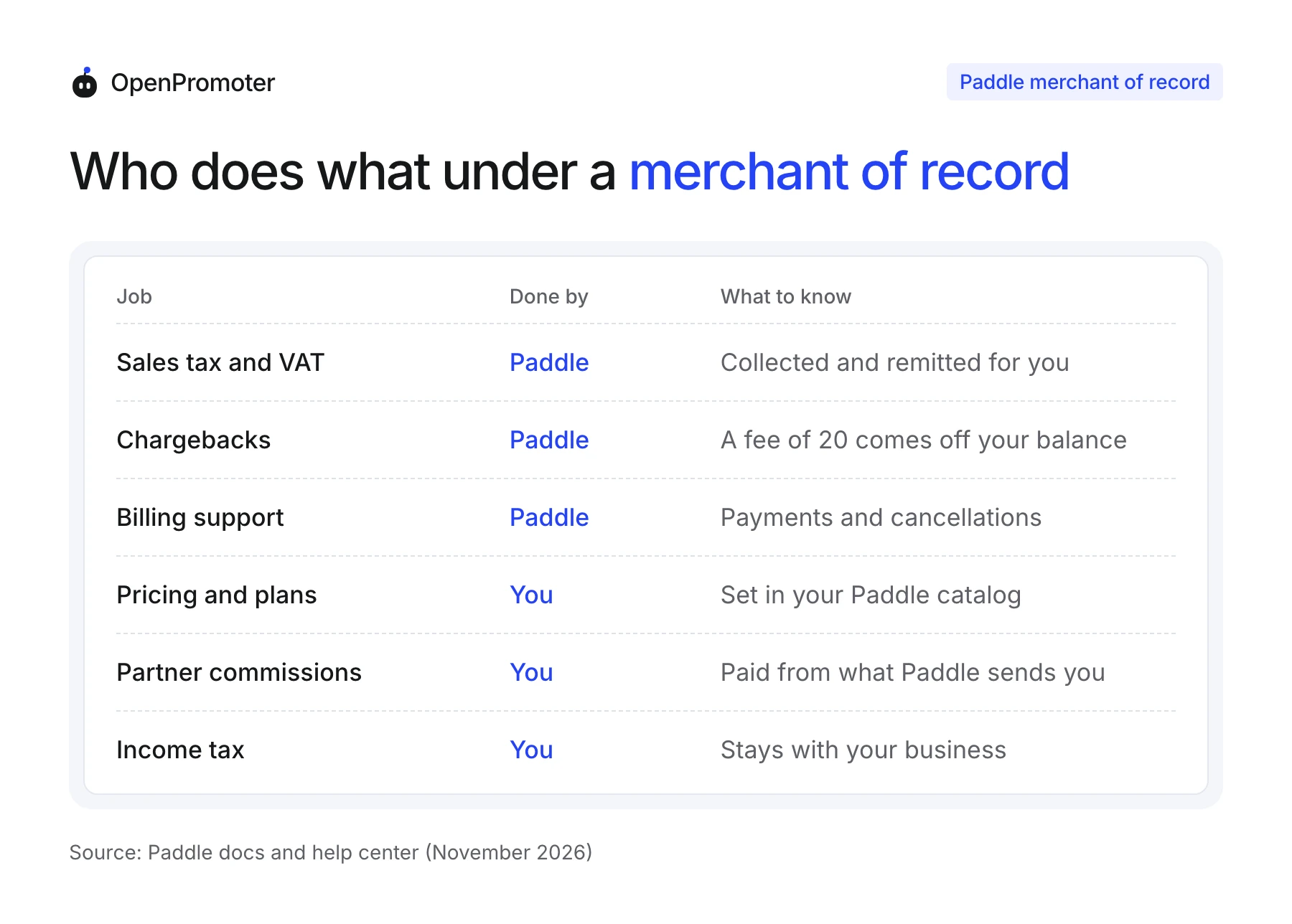
Note: Paddle handling tax does not end your own tax work. Income tax and any form you owe a partner stay with you. Our 1099-NEC threshold guide covers the partner side, and a tax advisor can answer the rest.
What Does a Paddle Merchant of Record Cost?
A Paddle merchant of record charges 5% plus 50 cents per checkout transaction as of November 2026. There is no monthly fee, and that price covers payments, tax, fraud screening, chargebacks and buyer support. Sales under $10 can get custom pricing from Paddle.
Its pricing page states the rate and the custom option. The flat 50 cents makes the fee a larger share of a small sale. We worked out each row below from the 5% plus 50 cents rate:
| Sale price | Paddle fee | Share of the sale |
|---|---|---|
| $10 | $1.00 | 10.0% |
| $29 | $1.95 | 6.7% |
| $49 | $2.95 | 6.0% |
| $99 | $5.45 | 5.5% |
| $500 | $25.50 | 5.1% |
A $29 plan pays 6.7% and a $500 annual plan pays 5.1%. Cheap monthly plans lose the most to the flat part of the fee.
What You Give Up With a Merchant of Record
You give up direct control over disputes, part of your branding and some freedom in how you set up the account. Paddle contests chargebacks with its own automated system and does not accept extra evidence from sellers. Your name appears on the customer's statement next to Paddle's.
Paddle's chargeback help page holds the details. These are the ones that cost money or time:
- Chargeback fee: Paddle deducts the disputed amount and a fee of 20 USD, GBP or EUR (40 CAD or AUD) from your balance. A won dispute returns the amount but not the fee.
- Dispute evidence: The system is fully automated and the page says extra seller evidence is not required or accepted.
- Chargeback rate: Paddle may ask for process changes above a 0.65% rate. A dispute you win still counts toward it.
- Early alerts: Paddle may refund a payment itself when a fraud partner warns of a coming chargeback. A fee still applies for the alert.
- Account checks: Paddle's Paddle 101 page lists a pricing page, terms of service, privacy policy and refund policy as the verification documents.
Say a $49 sale ends in a chargeback. Paddle's page says your earnings from that sale drop to zero, and you also pay the $20 fee. That one sale costs you $20 on top of the lost revenue.
Branding has one more side. The how Paddle works page says your name appears on the statement alongside Paddle's. It does not say your name leads.
Paddle also tracks what it keeps on a refund or chargeback. A 2025 changelog entry says transactions and adjustments now carry a retained_fee field. Check it before you assume a refund cost you nothing.
Is a Merchant of Record for SaaS Worth the Fee?
A merchant of record SaaS setup pays off when customers sit in many countries and you have no tax team. It adds a flat fee to every sale and takes some control away. If nearly all customers sit in one place where you already file, the fee buys much less.
This is our view and not a Paddle claim. Three questions settle most cases:
- Location: Where do your buyers live? Paddle's docs say you track no registration thresholds, which matters most with many small markets.
- Price: What is your average price? Use the fee table above. A fee of 10% on a $10 sale is a different decision from 5.1% on a $500 sale.
- Disputes: Who should fight them? Paddle fights them for you in an automated system. Some founders want that and some want control of the evidence.
Run the same arithmetic against your current setup. Add the fees you pay now to the hours you spend on tax filings and disputes. The comparison decides it.
Paddle Billing vs Stripe Managed Payments
Paddle Billing and Stripe Managed Payments both act as the merchant of record. Paddle sells into over 200 countries and territories. Stripe says Managed Payments handles tax in more than 80 countries, covers digital products only and needs a supported business location.
Stripe's requirements page and how it works page hold its rules. The table sets them next to the Paddle pages cited above:
| Topic | Paddle Billing | Stripe Managed Payments |
|---|---|---|
| Seller role | Authorized reseller of your product | Merchant of record that shows as Link |
| Tax | Sells into 200+ countries and territories | Tax handled in 80+ countries only |
| Disputes | Automated and closed to seller evidence | Stripe handles them and you can accept or counter |
| Statement | Your name alongside Paddle's | LINK.COM* plus your descriptor |
| Limits | Verification documents | Digital products only and a supported business location |
Note: Stripe's how it works page says: "Custom domains aren't supported on Managed Payments checkouts." Its requirements page says Managed Payments does not support Connect platforms or Express accounts (checked November 2026).
That second limit matters for partner payouts. OpenPromoter's Stripe payouts use Connect Express accounts. If you want Managed Payments and Stripe payouts together, ask Stripe whether one account can do both.
How a Merchant of Record Changes Affiliate Commissions
Paddle sends you the sale minus its fee, and a partner commission comes out of that smaller amount. Set the commission on the price before tax and decide whether Paddle's fee counts. Refunds and chargebacks also come out of your balance.
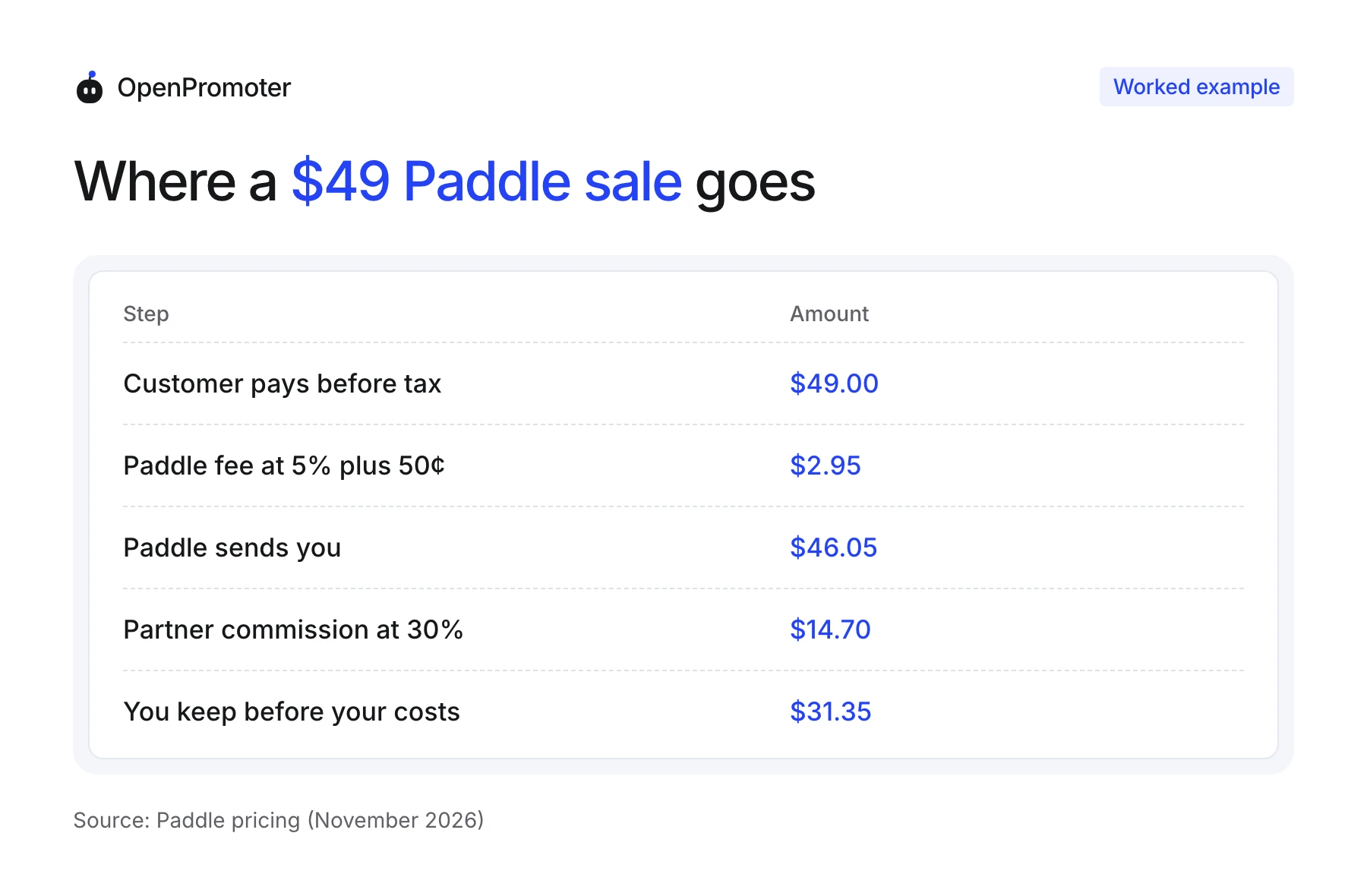
Take a $49 plan with a 30% commission of $14.70. Paddle's fee is $2.95, and Paddle sends you $46.05. After the commission you keep $31.35 before your own costs.
Four rules keep a Paddle affiliate program honest:
- Base: Pay on the price after discounts and before tax. Tax is not your revenue, because Paddle remits it.
- Rate: A 30% rate is 31.9% of the $46.05 Paddle sends you. Check your margin against that figure and not against the list price.
- Refund hold: Hold commissions through your refund window. A chargeback fee of $20 is yours alone and no partner shares it.
- Coupon codes: Paddle's webhooks name a discount by its ID and leave out the code. Our guide to referral links and codes shows how a code credits a partner.
Partner payouts are a separate step. Paddle pays you and you pay your partners, usually through PayPal, Wise or Stripe. Our guide to paying affiliates compares the options.
Fraud also reaches a Paddle program. A partner who pushes refund-prone buyers earns commissions that later reverse. Our guide to preventing affiliate fraud lists the signs.
How OpenPromoter Tracks Paddle Sales
OpenPromoter reads Paddle Billing through a webhook and books a commission from each completed transaction. It counts the sale as Paddle reports it, after discounts and before tax. A refund or a chargeback event from Paddle then changes that commission on its own.
We make OpenPromoter. Read this section with that in mind. The billing providers docs hold the setup steps, including the webhook URL and the click id that your checkout passes as custom data.
The Paddle integration page shows the flow.

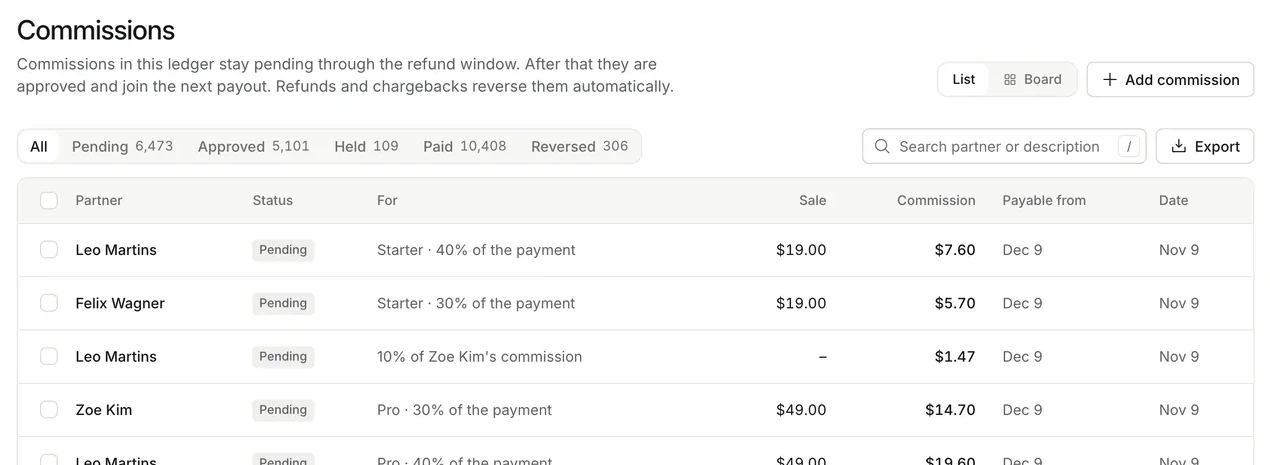
The commission ledger shows the result. A partial refund cuts a commission by the refunded share, and a chargeback warning from Paddle holds it. A lost chargeback reverses it and a won one releases it, as the commissions docs list.
OpenPromoter does not subtract Paddle's fee from the sale. If you want the rate to apply after the fee, lower the rate to match.
Conclusion
The Paddle merchant of record model trades 5% plus 50 cents per sale for tax, chargeback and billing work. It suits SaaS companies that sell in many countries without a tax team. It suits small monthly plans less, because the flat 50 cents takes 10% of a $10 sale.
Before you commit, check the fee at your price, the $20 chargeback fee and how Paddle's automated disputes sit with you. If you also run an affiliate program, pay on the sale before tax and hold commissions through your refund window. Our guide to affiliate commission rates helps you set the rate itself.
Frequently asked questions
Is Paddle a merchant of record?
Yes. Paddle's docs call it a merchant of record for SaaS, mobile app, AI and digital product companies. It acts as the legal seller of each sale and takes on tax collection, chargebacks and refunds.
How much does Paddle charge as merchant of record?
Paddle's pricing page lists 5% plus 50 cents per checkout transaction and no monthly fee. That makes $2.95 on a $49 sale. Sales under $10 can get custom pricing.
Does Paddle handle sales tax and VAT for you?
Yes. Paddle says it calculates, collects and remits tax, and that you do not register for VAT, GST or sales tax where you sell. Its digital products page explains the flow.
Who pays for a chargeback on Paddle?
You do, through your balance. Paddle's chargeback page says it deducts the amount and a fee of 20 USD, GBP or EUR. A won dispute returns the amount and keeps the fee.
Can you run an affiliate program on Paddle?
Yes. Paddle sends webhooks for completed transactions, refunds and chargebacks, and an affiliate tool can read them. OpenPromoter does this for Paddle Billing and books commissions from the sale before tax.
Do you still pay any tax yourself with Paddle?
Yes. Paddle handles the sales tax on your sales, and your own income tax and any partner form such as a 1099-NEC stay with you. Ask a tax advisor about your case.