
Referral incentives are the rewards you give customers for bringing you new paying customers. The best one costs a small share of what the new customer is worth. For most SaaS products that means a small credit or discount that is paid after the friend's first payment clears.
This guide uses two peer-reviewed studies, a university field experiment and Stripe's billing docs, all read in November 2026. One thing to know first: we make OpenPromoter, and our own product gets one short section near the end.
You get a way to set a ceiling on the reward before you pick a number. Then you see whether the friend should be paid too and what bigger rewards do to profit. A table of ideas shows what each one costs, and the OpenPromoter docs cover the setup steps.
What Are Referral Incentives?
Referral incentives are what a company gives to people who refer new customers. The reward can be account credit, a discount, free months, cash or a gift. It can go to the person who shares, the friend who joins or both.
A set of rules ties the reward to a paid sale. Referral incentive programs add the rest of the structure. They name who qualifies, when the reward is released and what stops abuse.
Two things set the price of any incentive: what the customer is worth and when you pay. A reward paid at signup costs more than one paid after the first invoice, because some signups never pay.
Our guide to a SaaS referral program covers those rules and six real programs. This guide stays on four questions: what to offer, how big it should be, who gets it and in what form.
What Is a Good Referral Incentive for SaaS?
A good referral incentive costs a small share of the gross profit that a referred customer brings. Work out that profit first and pick the share you will spend, such as a quarter or less. The reward is whatever fits under that line.
Here is the sum with round numbers. Say a plan costs $49 a month and referred customers stay 12 months on average. That is $588 in revenue.
At a 70% gross margin, each customer brings about $412 in gross profit. If you will spend a quarter of that to win one, the ceiling is about $103.
A $25 reward uses 6% of the profit. A $100 reward uses 24%.
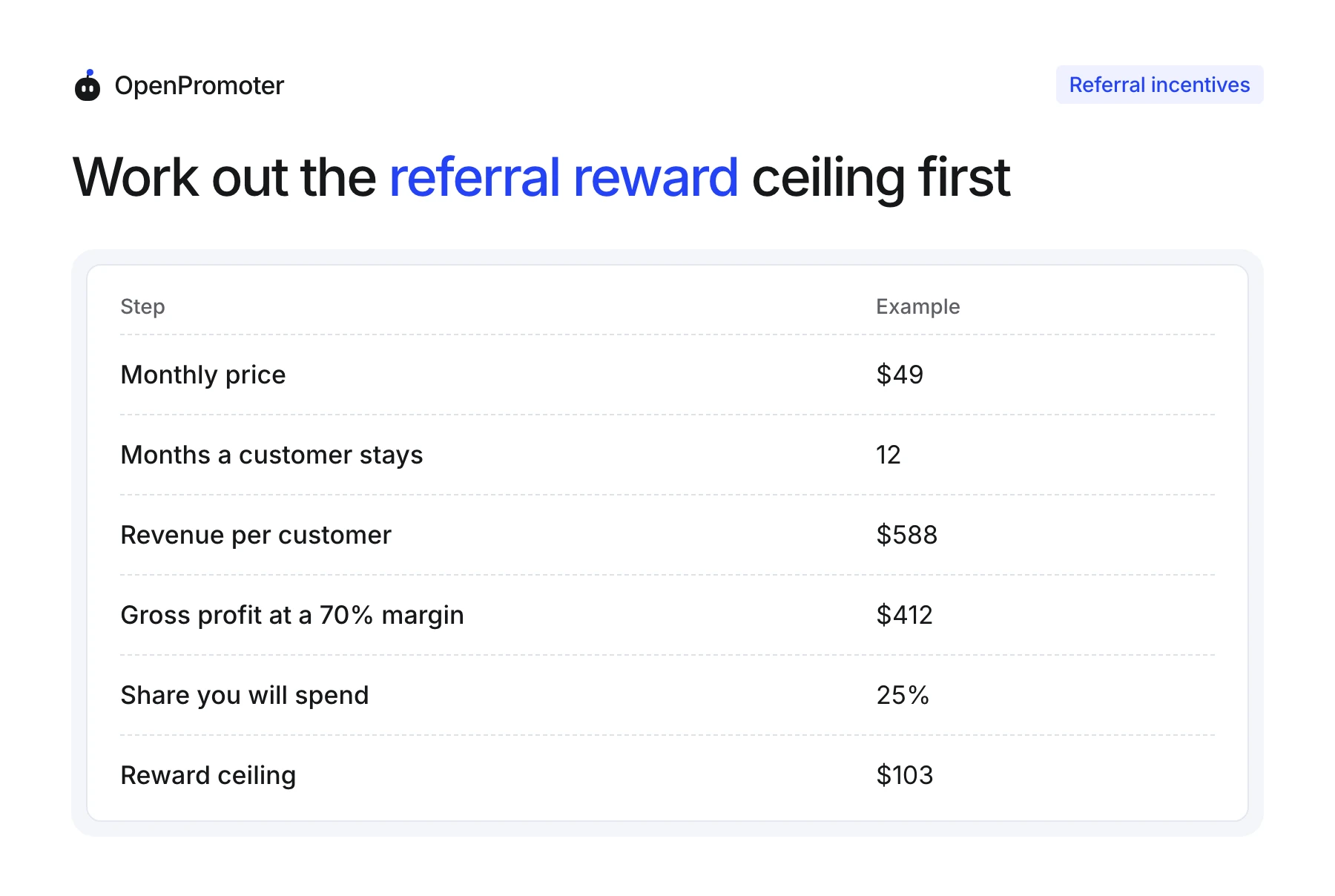
The ceiling is a limit and not a target. You can pay far less and still get referrals.
Real data on what referred customers are worth is rare. A study of about 10,000 customers of a German bank is one of the few. It found that referred customers were worth at least 16% more than similar customers who came another way (Journal of Marketing, January 2011).
The bank paid a €25 voucher per referral. The authors' managerial summary puts the value gap at €40 per customer. It puts the return at roughly 60% over six years (GfK MIR, 2013).
It is one bank in one industry. The authors also found that the gap varies by segment. They advise a selective program.
Note: Your own numbers beat any study. Use your real price and your real gross margin. Use how long your customers stay.
Is a Double Sided Referral Reward Worth It?
A double sided referral reward pays the friend as well as the customer who shares. Studies lean toward giving the friend something. In one field test, a reward for the friend brought a slightly higher conversion rate than the same reward for the sender.
That test comes from Washington University's Olin Business School. It emailed 6,364 customers of a startup and asked them to refer friends. The prize was a $5 gift card that went to the sender, the friend or both (WashU Olin, July 2020).
The conversion rate was low overall. The friend-benefiting offer was marginally higher than the sender-benefiting one. Follow-up studies repeated that pattern.
The same researchers sorted 351 referral programs by who gets the reward. Of those, 40.5% rewarded only the sender and 2.6% rewarded only the friend. About 55% shared the reward between both.
Most programs reward the sender. The test favored the friend.
A second study points the same way for cash. Jin and Huang ran four experiments. Monetary rewards performed even better when both the recommender and the receiver were rewarded (International Journal of Research in Marketing, March 2014).
For a SaaS product the friend's side is usually a discount. It costs nothing unless the friend pays. If you also pay the referrer a percent of each sale, that percent applies to the smaller price.
A 20% discount on a $49 plan leaves $39.20. A 30% commission on that is $11.76 and not $14.70.
How Big Should a Referral Reward Be?
A referral reward should be big enough to notice and small enough that profit still holds. Research on reward size finds that larger rewards bring more referred customers but make each one less profitable. Test two sizes and compare profit per customer.
That finding comes from Wolters, Schulze and Gedenk. Their abstract says that larger rewards increase the number of referred new customers but decrease the profitability of those customers (Marketing Science, November 2020).
A bigger reward can pull in people who want the reward more than the product. Those customers may leave sooner. Here is an example with made-up round numbers:
- Reward of $10: 30 referred customers who each bring $412 in gross profit. After the reward that is $402 each, or $12,060 in total.
- Reward of $25: 40 referred customers who each bring $320 in gross profit. After the reward that is $295 each, or $11,800 in total.
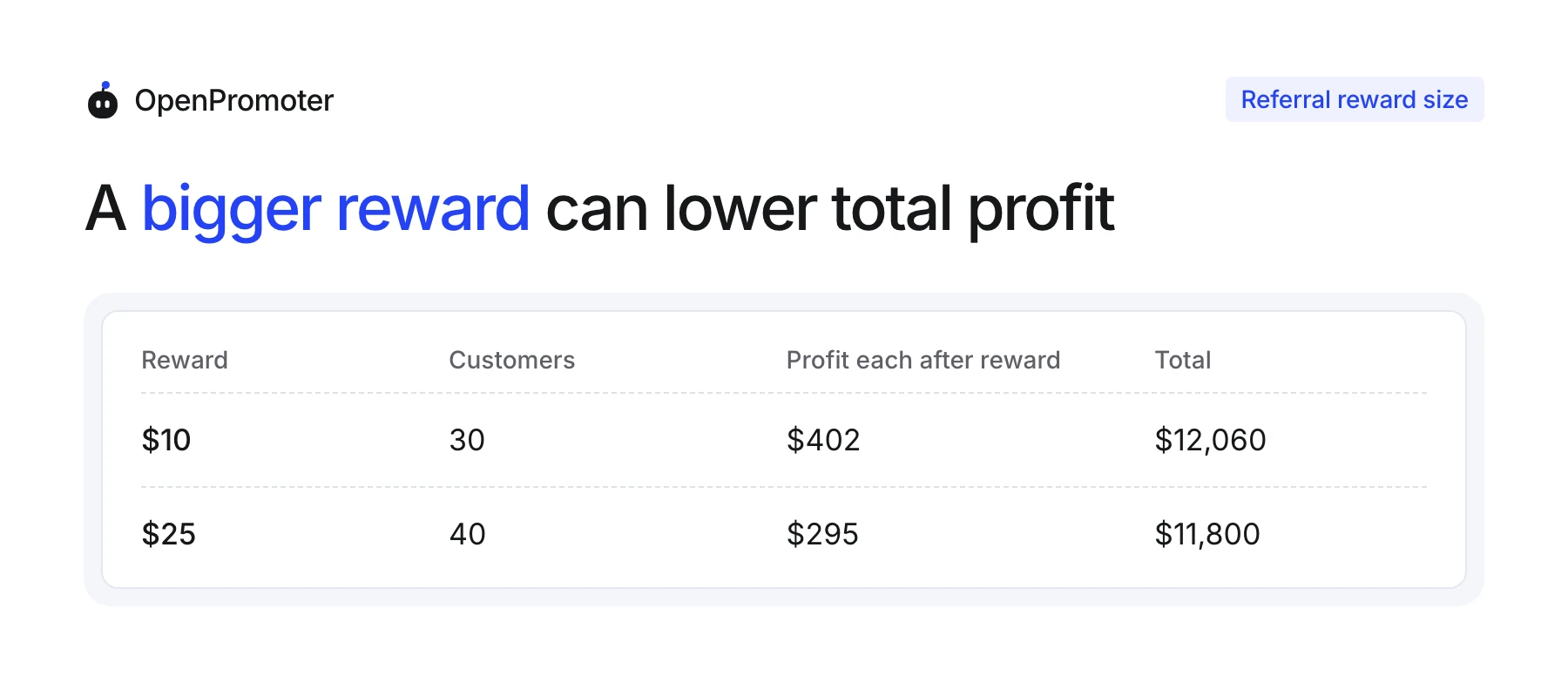
The bigger reward won on sign-ups and lost on profit. Your numbers will differ, which is why you test. Run each size for a full billing cycle and track what each referred customer pays after the reward.
Do not read this as a case for tiny rewards. The bank authors judged that their €25 fee was set low. They said a higher reward could still pay back.
They also said firms should work out the number from their own program and not copy rivals (Journal of Marketing, January 2011). Start well under your ceiling and raise it in steps.
Credit vs Discount vs Cash: Which Referral Reward Works Best?
Credit and discounts cost you less than cash at the same face value, because customers can spend them only on your product. Cash is simple to understand but adds payouts and tax forms. Research finds that cash can backfire when the recommendation feels weak.
That is the Jin and Huang result. Consumers preferred money to in-kind rewards for its economic value. The social cost of taking money offset that benefit and made money an inferior incentive when the recommendation was not well justified.
The same study found that money worked as well as an in-kind reward once the amount was large enough. A small cash reward is the weakest version. A small credit sits well with a product people already like.
Stripe sets two defaults that shape how credits and discounts behave. A customer's invoice balance applies to the next finalized invoice by default, as the Stripe invoice balance docs explain. A coupon's duration defaults to once, which covers only the first invoice, according to the Stripe coupon docs.
Check both before you promise "a free month" or "20% off for 3 months". Set the duration on the coupon yourself. Our guide to Stripe promo codes lists the limits a code can carry.
Billing cadence matters too. On a monthly plan the next invoice is a month away. On an annual plan the credit may wait a year before the customer sees it.
A friend's discount works the other way. It shows up on the first invoice and the friend feels the reward at once. That is one reason the friend's side is usually a discount and the referrer's side is credit or cash.
Referral Incentive Ideas and What Each One Costs
Most referral incentive ideas are variations on a few rewards. Each one has a different cost to you and a different catch. The table lists the ideas that suit a subscription product and the one detail to check before you launch each.
| Idea | What it costs you | What to check |
|---|---|---|
| Account credit | Margin on the next invoice | Stripe applies it to the next invoice by default |
| Free months | The monthly price for each free month | Set the coupon duration yourself |
| Friend discount | A cut in the first invoices | It lowers the price a percent commission applies to |
| Fixed cash reward | The full amount | Payout fees and tax forms |
| Signup reward | A payment before the friend pays | It pays for free accounts that never convert |
| Tiered rate | A higher share for top referrers | It fits repeat referrers and not one-time customers |
Match the idea to your billing. A monthly plan suits credit and discounts. An annual plan suits a one-time reward paid after the first invoice clears, since credit would wait a year to land.
Pick one idea for the customer who shares and at most one for the friend. A reward that needs a paragraph to explain will not be shared. If you cannot say it in one sentence, simplify it.
Pay on a paid invoice and wait out your refund window. That keeps the reward tied to revenue you have already collected.
Our guide to affiliate commission rates shows what a percent reward looks like when it grows into a partner program. Move a customer there when they start referring every month.
How OpenPromoter Sets Referral Incentives
OpenPromoter has one setting for the friend and one for the referrer. The friend gets a discount for a set number of months, and you can back it with a Stripe coupon. The referrer earns a commission with its own type, rate and duration.
We make OpenPromoter. Weigh this section with that in mind. Three screens cover it, and the docs hold the click path for each.
- The friend's reward: The Reward for the customer card takes a discount percent, a number of months and an optional Stripe coupon id. See the commission docs.

- The referrer's reward: The Commission card sets a percent or a fixed amount per payment. You choose first payment only, a number of months or the customer's lifetime. A per signup reward pays before the friend buys.
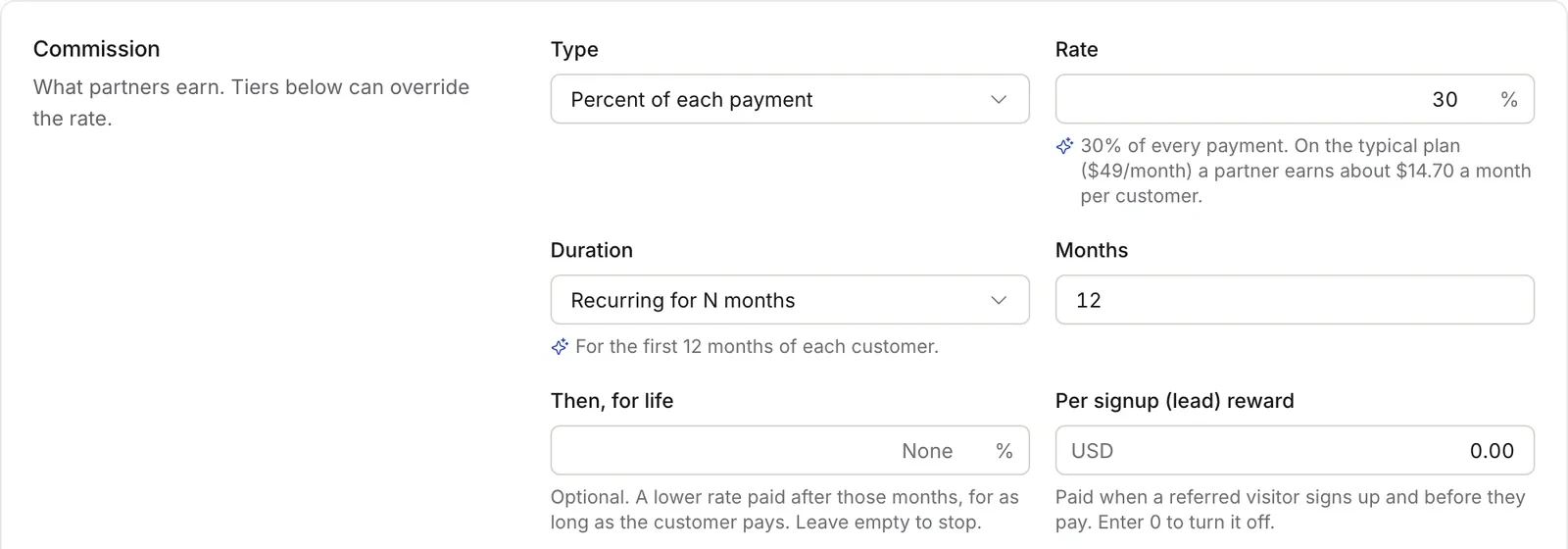
- The referrer's view: The program page shows the rate, how long it is paid, the refund window and the friend's discount in one statement.
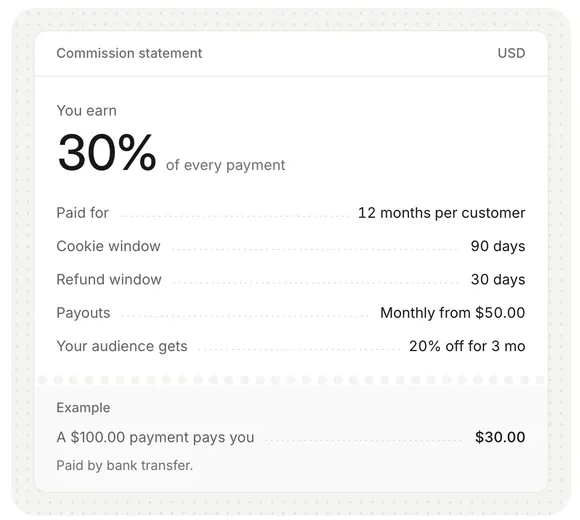
A fixed amount on the first payment only gives a flat reward, like a customer referral credit. A percent for a set number of months gives a running share, like a partner commission.
The rate applies to what the customer paid after discounts and before tax, as the docs say. The 20% friend discount lowers the commission base. That is the $11.76 example above.
Commissions wait through a refund hold of 30 days by default. The payouts docs say you can raise it to 180 days. Customers can see their own link and earnings inside your app with the embedded referral dashboard.
Conclusion
The right referral incentives start with a ceiling. Work out the gross profit of a referred customer and decide what share you will spend. Then pick a reward that fits under it.
Reward the friend as well when you can. Test two reward sizes and compare profit per customer. Credit or a discount usually beats cash for a product people already like.
Pay only on a paid invoice and wait through the refund window. Our referral links vs referral codes guide shows how to hand out the reward.
Frequently asked questions
Should every customer get the same referral reward?
Not necessarily. The bank study found that referred customers varied in value by segment, and its authors advised a selective program. A flat reward is easier to explain and a fine place to start.
Can I pay referral rewards in free months?
Yes, a Stripe coupon can cover a set number of months. Set the duration yourself because it defaults to once. Count each free month as a cost equal to your monthly price when you work out your ceiling.
Are referral rewards taxable?
Cash rewards can bring tax forms for the business that pays them. The rules depend on your country and on whether the reward counts as pay for a service. Ask a tax advisor, and see our 1099-NEC threshold guide for the US forms.
Is a referral incentive the same as an affiliate commission?
Not quite. A referral incentive usually rewards a customer once with credit or a discount. An affiliate commission pays an outside partner a share of each payment, and our SaaS referral program guide sets the two side by side.
What happens to the reward if the friend gets a refund?
A refund inside the hold cancels the reward before it is paid. That is why you release rewards only after the refund window. State in your terms what happens when a refund comes later.
Can I change a referral reward later?
Yes. Change it for new referrals and keep every reward already earned. Announce the change before it starts and compare profit per referred customer over at least one billing cycle.