
A Stripe promo code is a customer-facing code on top of a coupon. You can give one to each affiliate or influencer. The customer types it at checkout and you can see whose code was used.
This guide uses Stripe's coupon, Checkout and Payment Links docs, all read on November 23, 2026. It also uses the OpenPromoter docs and the code that creates partner codes. One thing to know first: we make OpenPromoter, and it gets one short section near the end.
You get the limits that matter for creators and the traps in Stripe's rules. You also get a way to choose between one coupon or many. Stripe's own docs give the click path, and we link them and skip the steps.
What Is a Stripe Promo Code?
A Stripe promo code is a promotion code, which is a customer-facing string that points at a coupon. The coupon holds the discount rule and the percent or amount off. The code holds the word that a customer types at checkout.
Stripe's coupon docs say many promotion codes can reference one coupon. A code is active only while its coupon is still valid.
People also search for a Stripe coupon code or Stripe discount codes. They all land on the same object, the promotion code. Stripe promotion codes are what you hand to a creator.
Stripe Coupon Code or Promotion Code for Each Partner?
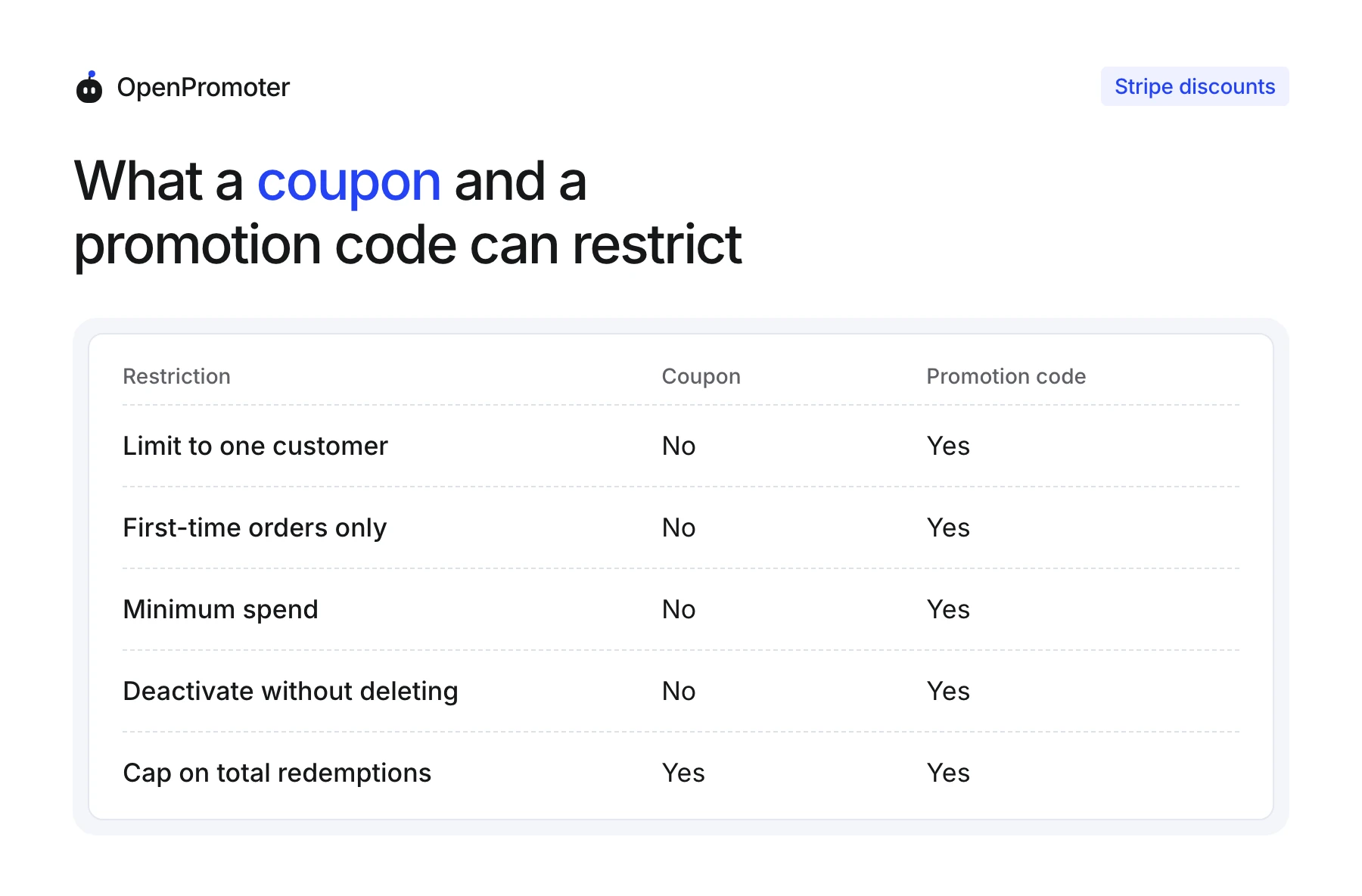
Give each partner their own promotion code and let the codes share one coupon when the offer is the same. Make a separate coupon only when a partner gets a different deal. A coupon alone cannot be limited to first-time buyers, and a code can.
Stripe lists three things a code can do and a coupon cannot: restrict to one customer, restrict to first-time orders and set a minimum spend. That is the reason to hand creators a code and not a coupon.
| Setup | Best when | Watch for |
|---|---|---|
| One coupon with a code per partner | Every creator gets the same offer | One creator can use up the shared cap |
| One coupon per partner | Each deal is different | More coupons to track and retire |
| A coupon with no code | You apply it from your own back end | Nothing for a creator to share |
The shared cap is the trap. A coupon's max_redemptions counts every redemption across all its codes, as Stripe's coupon docs explain. Ten creators on one coupon capped at 500 share those 500.
A promotion code can have its own cap, but never a higher one than its coupon. Stripe also keeps a times_redeemed count on each code. That count tells you how many sales each creator's code produced.
Tip: Leave the coupon cap empty or high. Put the real limit on each code. Then one creator cannot drain the offer for the rest.
How Do You Create a Promo Code in Stripe?
Create the coupon first and then add a promotion code on it. In the Dashboard this is one form that starts at Coupons. Through the API it is two calls, one to coupons and one to promotion_codes, and both are documented.
Stripe documents both paths and shows the code samples in its Checkout discounts guide. A code you create inherits the configuration of its coupon. So set the percent, duration and any cap on the coupon before you add codes.
If you leave the code blank Stripe makes a random one. A creator needs a word they can say or type. Set the code yourself.
Which Stripe Promo Code Limits Matter for Influencers?
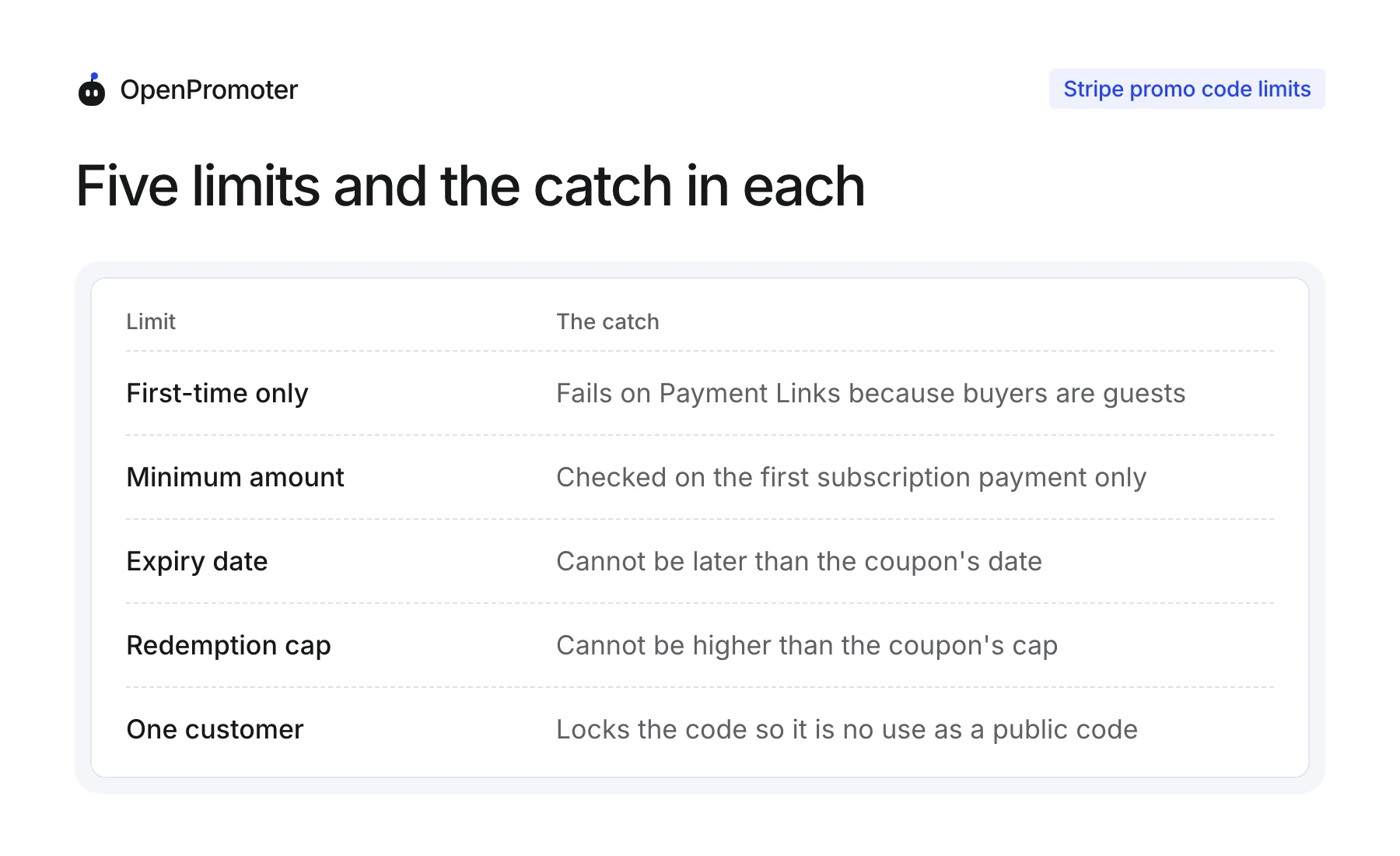
Five limits matter once a code leaves your hands: first-time only, a minimum amount, an expiry date, a redemption cap and a customer lock. Each one has a catch that Stripe states in its promotion code docs. Read the catch before you rely on the limit.
- First-time customers only: Stripe counts a customer as returning if they started a PaymentIntent, even without paying. A canceled trial also counts. Payment Links create guest customers for one-time payments. This limit does not work as expected there.
- Minimum amount: Stripe checks it at redemption. For a subscription it applies only to the first payment. A later renewal below the minimum still gets the discount.
- Expiry date: Set
expires_aton the code. It cannot be later than the coupon'sredeem_by. If you leave it empty the coupon's date fills in. - Redemption cap: The code's cap cannot exceed the coupon's cap.
- Customer lock: Pass a customer and only that customer can redeem the code. This suits a one-to-one deal and not a public creator code.
The coupon docs add one more limit. A code with amount restrictions cannot be applied to subscription items or invoice items. If you add discounts from your own back end, check this before you ship.
How Long Does a Creator Discount Last?
A coupon's duration is once, repeating or forever. The default is once, which discounts only the first invoice of a subscription, and a repeating coupon runs for the months you set. A forever coupon discounts every invoice for as long as the subscription lasts.
The duration decides how long the customer pays less. It also decides how much the creator earns on each renewal.
OpenPromoter books commissions on the amount the customer paid after discounts, as the Stripe docs say. A longer discount means smaller commissions for longer.
Say a $40 monthly plan has a 25% coupon for 3 months and a 20% recurring commission. The customer pays $30 and the creator earns $6 for three months. From month 4 they pay $40 and the creator earns $8.
Yearly plans behave differently. In Stripe's duration example a 50% coupon with a 4-month duration discounts the entire year on a yearly plan. That holds when the subscription renews inside the 4-month window.
Note: A coupon applied to a backdated subscription starts counting from the backdated start date. A repeating coupon can lose months before the first invoice.
What Characters Can a Stripe Promo Code Use?
A Stripe promo code may use only letters, digits and dashes, and a name such as MAYA_20 is rejected. Spaces are not valid either. The code is case-insensitive, and maya20 and MAYA20 count as the same name for every customer.
Stripe states this in the promotion code reference. Pick a name that fits those rules before you give it to a creator.
A code must be unique across active promotion codes for each customer. A code any customer can redeem cannot be created twice while the first is active. You can deactivate a code and then reuse the name.
Creators say codes aloud on podcasts and in videos. Pick a short name and add a number, such as MAYA-20. Avoid pairs that sound or look alike, such as 0 and O.
Stripe lets you delete a coupon but not deactivate it. Deleting a coupon archives its codes. To pause one creator, switch off that code's active flag and leave the coupon alone.
Can an Influencer Share a Code and a Link Together?
A creator can share both because a Payment Link accepts a prefilled_promo_code URL parameter. The link then carries the code and checkout opens with the code already filled in for the buyer. Checkout still allows only one coupon or promotion code per session.
That limit matters when you run a Black Friday affiliate campaign or any store-wide sale. A customer cannot stack a sale coupon and a creator's code, as the Checkout discounts guide says. Decide which offer wins before you launch.
A prefilled code helps when an audience clicks and forgets to type. Our referral link vs code guide covers when each one fits.
Do Creators Have to Disclose a Promo Code?
A creator who gets paid or discounted products for a post has a material connection to the brand, and the FTC says to disclose it. A commission on sales is a financial relationship. Put the rule in your partner terms and ask for a clear label on every post.
The FTC's Disclosures 101 guide (November 2019) says a material connection includes "a financial relationship." Its examples are a brand paying you or giving you "free or discounted products or services."
It also tells creators to disclose the relationship "if you got anything of value." The page does not name commissions. Treat this as background and ask a lawyer how it applies to you.
Our affiliate agreement template guide covers where the disclosure clause goes.
How OpenPromoter Tracks Stripe Promo Codes
OpenPromoter credits a sale to the partner whose code the customer used and needs no click. It reads the code from the Stripe checkout session and from the paid invoice. Weigh this section knowing that we make OpenPromoter and that it is one tool among many.
Add the code on the partner's page. If you also enter a Stripe coupon ID, OpenPromoter creates the promotion code on that coupon in your Stripe account. It writes the code in capital letters and tags it with the partner's ID in metadata.
It sets no limits of its own and the coupon's limits apply. Set the cap and the expiry on the coupon first. See partners for the screen and the Stripe setup docs for the connection.
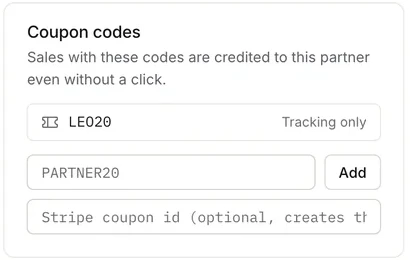
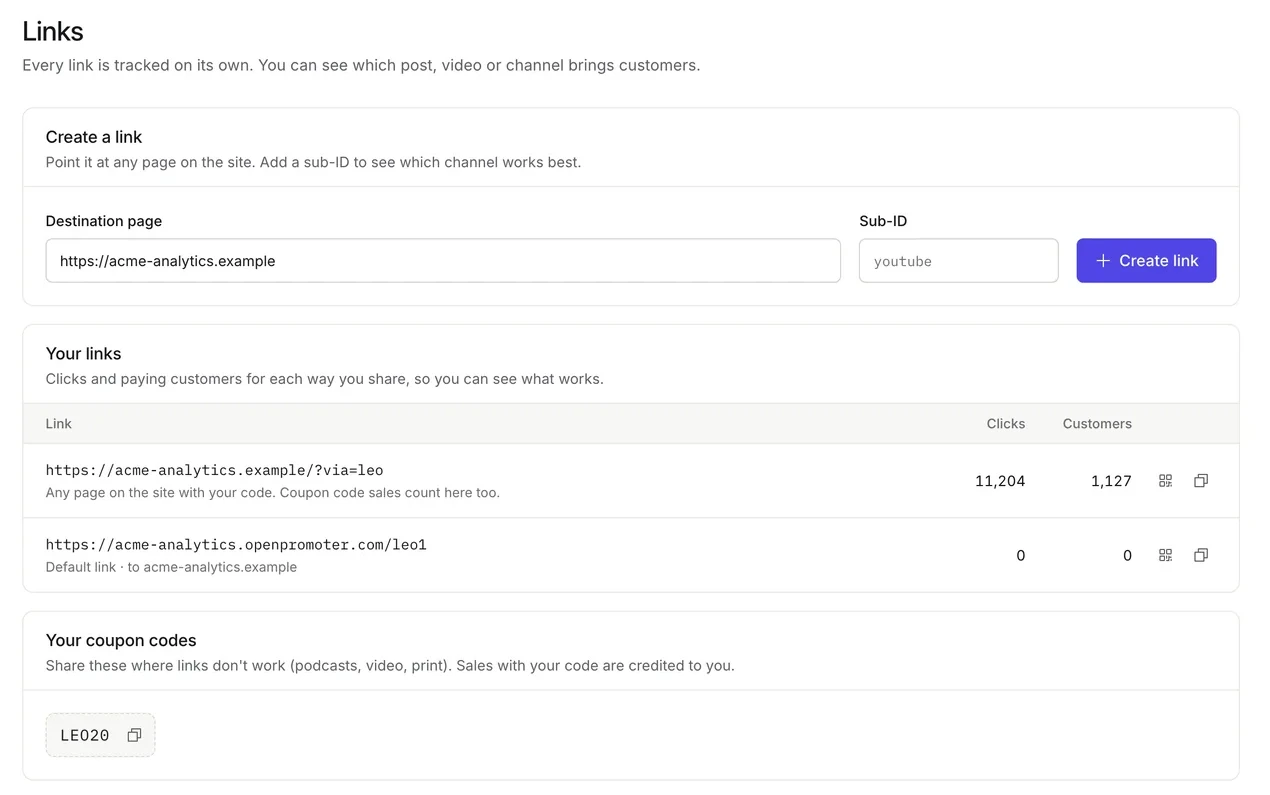
Partners see their code next to their tracked link in the portal. When a code and a click both appear on one sale, the typed code wins, as the tracking docs explain.
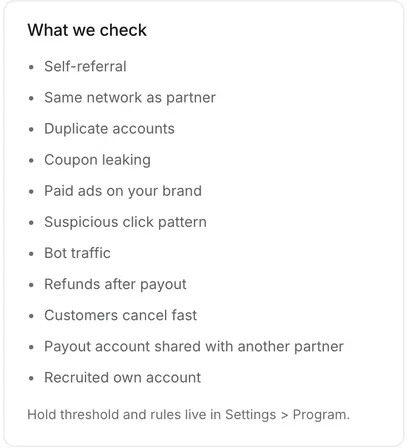
The Fraud page flags coupon leaking. It raises a flag when at least 80% of 5 or more referrals used the code with no click.
A code posted on a coupon site gives away your offer and pays a creator who did no work. See fraud checks.
Our Stripe integration page lists what else the connection reads. Our Stripe affiliate program guide covers the wider setup.
Conclusion
A Stripe promo code lets you credit each creator and cap what they give away. Use one coupon for the offer and one code per partner. Put the redemption cap and expiry where Stripe lets them bind every code.
Check the traps before launch. First-time-only codes fail on Payment Links, a shared coupon cap is shared by every creator, and duration sets how long commissions stay smaller. Then name each code so a creator can say it aloud.