
Referral program meaning comes down to one idea: a referral program rewards people for sending new customers to a business. The reward is paid when the friend they recommend buys. The business pays for results instead of paying for ads.
We read a peer-reviewed bank study, Dropbox's public help pages and the FTC's endorsement FAQ in November 2026. One thing to know first: we make OpenPromoter. So the definition and the data come first, and our own tool gets one short section near the end.
This guide explains what a referral program is and how it works step by step. It then covers the main types, what the evidence says about results and the rules to write before launch.
Referral Program Meaning in Plain Words
Referral program meaning is simple: it is a structured way to reward people who recommend your product. Each member gets a tracked link or code to share. When someone they referred buys, the member earns a reward such as cash, credit or a discount.
Four terms appear in almost every program:
- Referrer: The person who shares the link or code.
- Referred customer: The person who arrives through it.
- Trigger: The event that earns the reward such as a first paid invoice.
- Reward: What the referrer gets, and sometimes what the friend gets too.
Word of mouth happens without tracking or a reward. A referral program adds both. Our guide to the SaaS referral program covers the setup for software companies.
How Does a Referral Program Work?
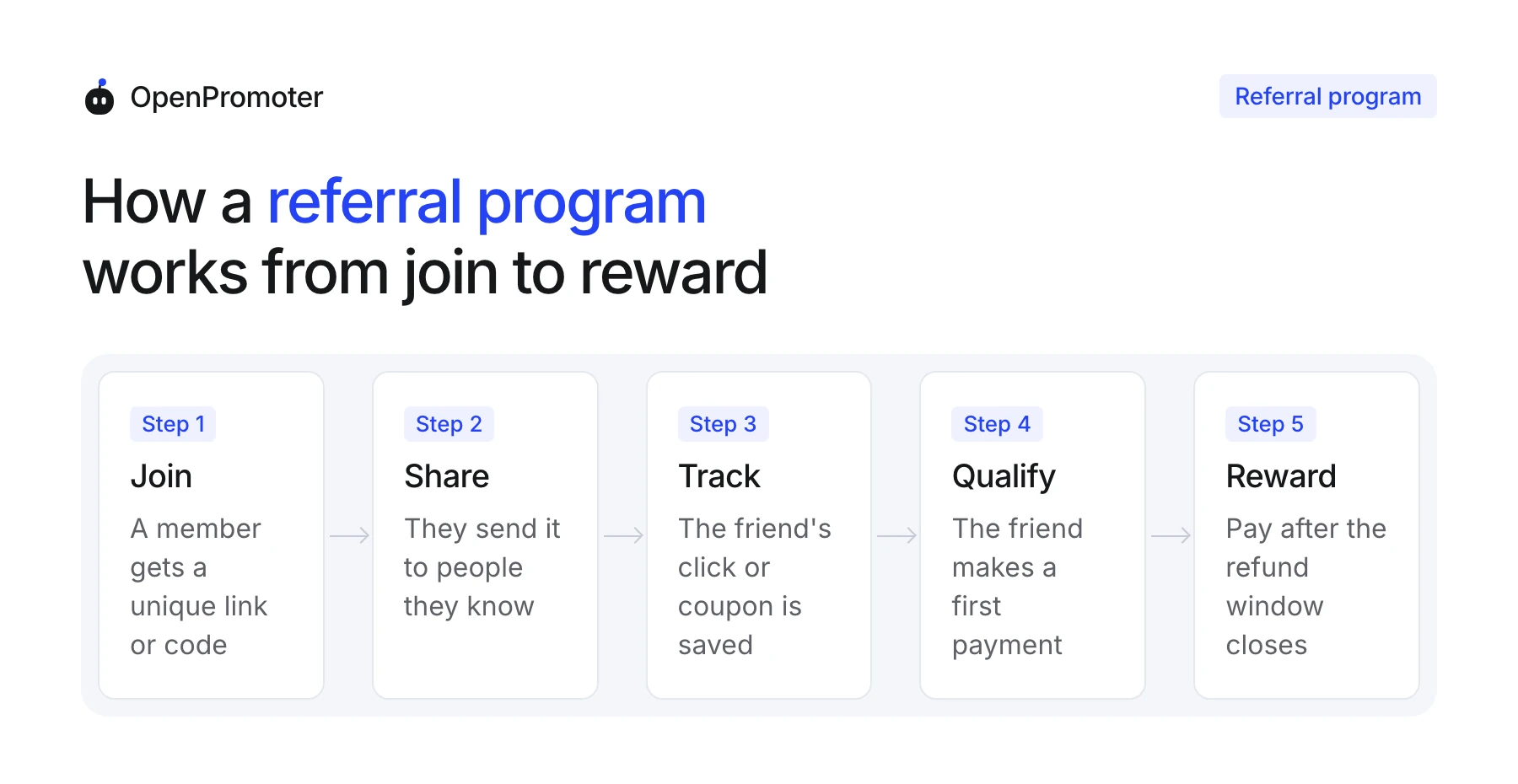
A referral program runs in five steps from invite to payout. A member gets a unique link or code and shares it with a friend. The software records the source, checks the sale and pays the reward after the refund window closes.
Here is what each step does:
- Join: A customer or partner signs up and receives a unique link or code.
- Share: They send it by email, message or social post.
- Track: The friend's click or coupon is saved against the referrer, often in a browser cookie.
- Qualify: The reward fires on a set event such as a first payment.
- Reward: The referrer is paid or credited once the refund window has passed.
Step 4 sets your cost. A program that pays for signups pays for people who never buy. A program that pays for payments only costs money when revenue arrives.
Step 3 has two common forms. Our guide to referral codes shows when a code beats a link.
Types of Referral Programs
Referral programs differ by who is rewarded and what that reward is worth. A one-sided program pays only the referrer while a double-sided program also rewards the friend. Tiered programs raise the reward as a member refers more people over time.
| Type | Who gets rewarded | Example |
|---|---|---|
| One-sided | The referrer only | A credit when a friend pays |
| Double-sided | Referrer and friend | Dropbox gives both sides extra storage |
| Tiered | The referrer at a rising rate | A higher rate after 10 paying referrals |
| Partner referral | A business that sends buyers | A fee for each qualified lead |
A one-sided program is the simplest to run. A double-sided program gives the referrer something to offer a friend and it costs more per sale because you pay both sides. Work out the combined reward before you launch.
The reward itself can be cash, account credit, a discount or free product time. Our guide to referral incentives covers how big each reward should be.
Do Referral Programs Work?
Referral programs work when a referred customer is worth more than the reward you pay. A study of a German bank found referred customers earned about 25% more margin and left about 18% more slowly. It covers one company but shows the size of the gap.
Schmitt, Skiera and Van den Bulte compared almost 10,000 accounts over 33 months. Their summary in GfK Marketing Intelligence Review (2013) also reports a six-year lifetime value that was 16% higher.
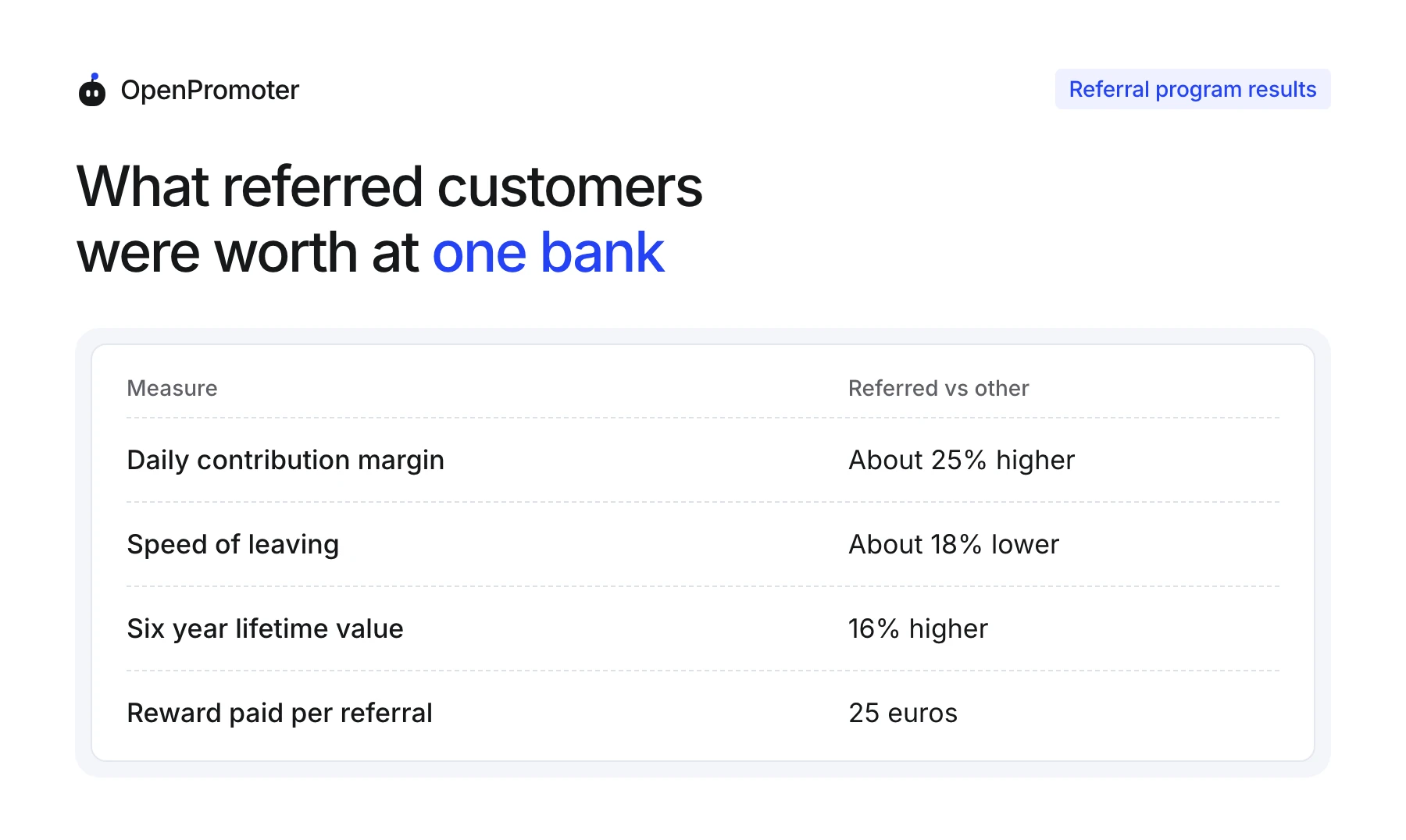
The bank paid 25 euros per referral against an average lifetime value gap of 40 euros. The authors put the return at roughly 60% over six years.
As an example, say a referred customer is worth $40 more than one from ads. A $25 reward leaves you $15 ahead. A $45 reward loses money.
Note: The bank study covers one company in one industry. The authors advise targeting referrals at the customers who are worth most and checking results over time.
Trust is the other reason. A Nielsen survey reported in September 2012 found 92% of respondents trusted recommendations from people they know. The survey is old but the ranking has held across Nielsen's later editions.
Referral Program vs Affiliate Program
A referral program usually rewards customers who share with people they know. An affiliate program rewards promoters who reach a public audience. The tracking works the same way in both and the difference is who joins and finds the buyers.
Referral members are mostly users with a few friends or colleagues in mind. Affiliates are often creators, reviewers and agencies with an audience. Many companies run both on one system and give each group its own rate.
Pick a referral program when your best promoters are customers. Pick an affiliate program when they are creators with an audience. If you are unsure start with the group you already hear from.
Our guide to the affiliate marketing platform market explains how the software for each differs.
Example: How Dropbox Runs Its Referral Program
Dropbox gives bonus storage to both sides of a referral. Its help center says Basic accounts earn 500 MB per friend up to 16 GB. Plus, Family and Professional accounts earn 1 GB per friend up to 32 GB in total.
The Dropbox help page was updated in September 2026. It says both people receive the space once the friend accepts the invite, installs the app, logs in and verifies an email address.
Three design choices stand out. The reward is extra product that costs little to give and a cap limits the cost per member. The trigger is activation so a signup alone earns nothing.
A software company can copy the pattern with money in place of storage. Pay a fixed credit per qualified referral and cap the total per member. Count a referral only after the friend's first payment clears.
What Rules Does a Referral Program Need?
A referral program needs written rules for four things. They are what counts as a qualified referral, when the reward is paid, how self-referral is blocked and what referrers must disclose. Put them in short terms that members see before they share.
- Qualified referral: Name the event that earns the reward and how long a referral stays attached to the referrer.
- Payment timing: Pay after the refund window so a refund never leaves you paying for a lost sale.
- Self-referral: Block members from referring themselves or their own accounts. Our guide to how to prevent affiliate fraud lists the checks.
- Disclosure: The FTC's endorsement FAQ says an incentive can need disclosure when it could change how readers weigh a recommendation. Tell referrers to say they get a reward.
How OpenPromoter Runs a Referral Program
OpenPromoter runs a referral program with tracked links, partner coupon codes and an optional friend discount. We make it and the docs cover every step. This section shows the settings that set your cost and decide who gets the credit for a sale.
The program page shows each person the rate, the payment length, the cookie window and the refund window before they join. The cookie window is 60 days by default and the refund hold is 30 days.
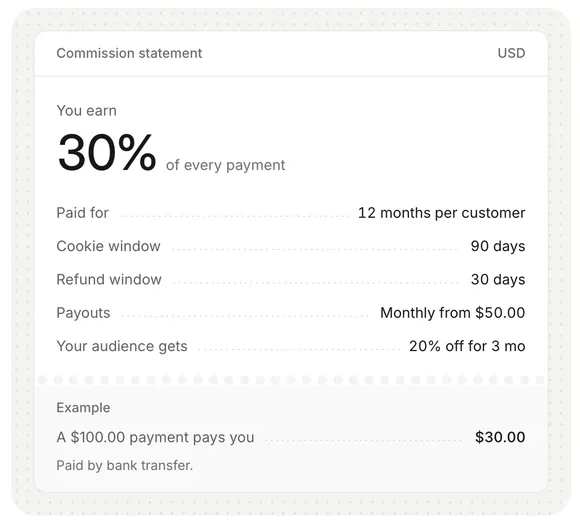
For a double-sided program the Reward for the customer card sets a discount percent and the number of months. Add a Stripe coupon id and the discount applies at checkout. See the commissions docs for the steps.

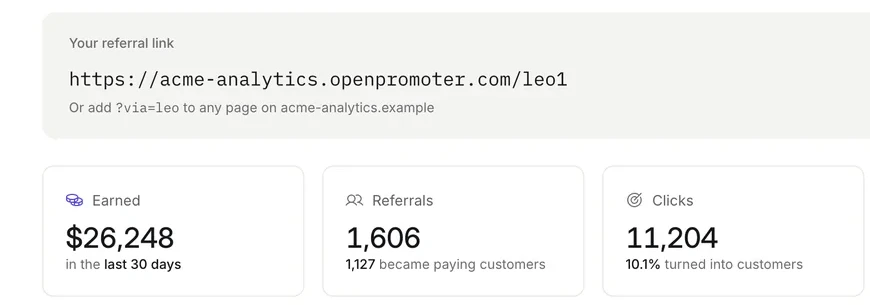
Each referrer sees their own link and results in the partner portal. A customer who typed the referrer's coupon wins over any earlier click. To show the link inside your product use the embedded dashboard.
Conclusion
Referral program meaning is short: a tracked way to reward people who bring you paying customers. It works as five steps from join to reward, and the trigger and the refund window set your risk.
The bank study shows why companies bother. A referred customer can be worth more than the reward you pay. Dropbox shows how a cap and an activation trigger keep the cost under control.
Write the rules first. Decide what qualifies, when you pay and how you block self-referral. Then pick a reward that costs less than the extra value a referred customer brings.
Frequently asked questions
What is a referral program in simple words?
It is a program that pays people for recommending your product. Each person gets a tracked link or code. They earn a reward when someone they referred becomes a paying customer.
How does a referral program work step by step?
A member joins and gets a link or code. They share it and the software records who arrived through it. The reward is paid after the friend qualifies and the refund window ends.
Are referral programs worth it?
They can be. A study of a German bank found referred customers produced about 16% more lifetime value over six years. Worth depends on keeping the reward below that extra value.
Is a referral program the same as an affiliate program?
The tracking is the same. Referral programs mostly reward customers who tell people they know while affiliate programs reward promoters with a public audience. Many companies run both.
Do you have to disclose a referral reward?
Often yes. The FTC says an incentive can need disclosure when it may affect how much weight readers give a recommendation. Tell referrers to say plainly that they earn a reward.
How much should a referral program pay?
Less than the extra lifetime value a referred customer brings. The bank in the study paid 25 euros against a 40 euro gap. Work out your own gap before you set a reward.